
Search "aviation software development" and you'll find a hundred agencies offering the same list: flight management, crew scheduling, MRO tracking, air traffic systems. Read closely and you'll notice something — almost none of them have actually built and shipped an aviation product. They're listing capabilities, not experience.
We built FlyHire, an aviation hiring platform, from the ground up — it shipped to the Apple App Store and Google Play, connecting pilots, mechanics, and aviation professionals with employers through AI-powered matching, verified logbooks, and smart résumés. That engagement wrapped once the client built out their own in-house team. So when I talk about what it takes to build aviation software, I'm talking about something we shipped, not something we could theoretically attempt.
Here's the honest version of what building for aviation actually involves.
Why aviation recruiting is genuinely different
You might think hiring is hiring — a job board is a job board, whether it's for marketers or pilots. That assumption is exactly why generic platforms fail in aviation.
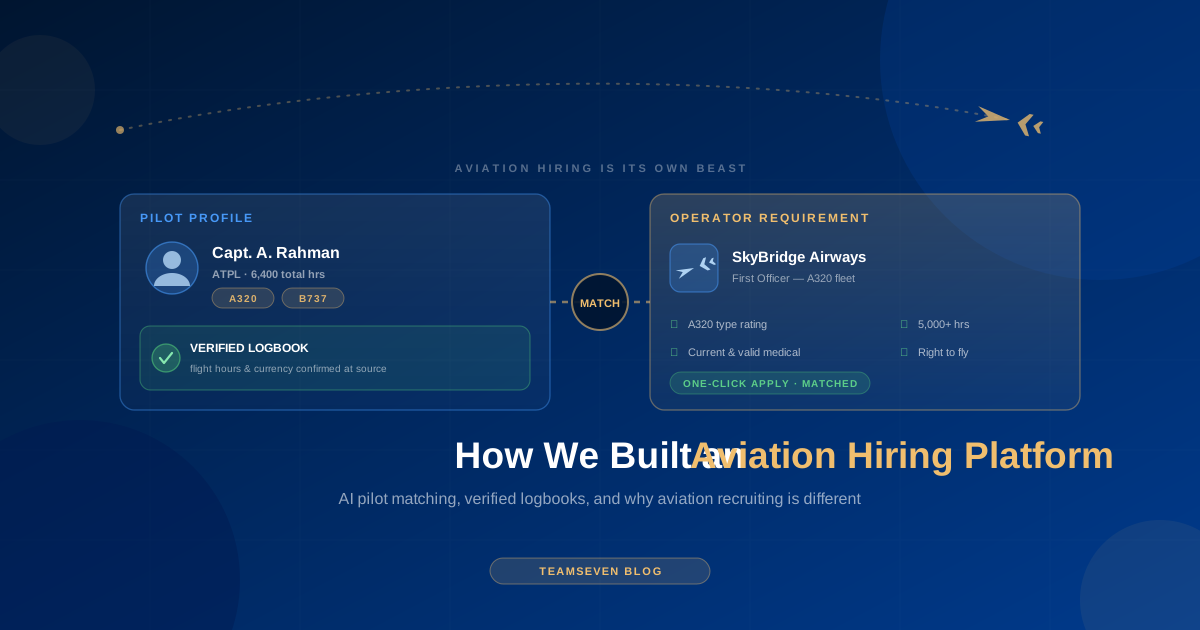
Aviation hiring has constraints that don't exist in normal recruiting. A pilot isn't just a "candidate with experience" — they have specific aircraft type ratings, a precise number of flight hours logged (total, plus by category, plus by aircraft), currency requirements, medical certificates with expiry dates, and certifications that have to be verified, not just claimed. An employer isn't looking for "someone good" — they're looking for someone typed on a specific aircraft, with a specific hours minimum, current, and legally able to fly in their jurisdiction.
A generic job board has no concept of any of this. It matches on keywords and job titles. In aviation, that produces noise — pilots seeing jobs they're not qualified for, operators drowning in applications from people who don't meet hard requirements that aren't negotiable. The entire value of an aviation hiring platform is in understanding these domain-specific constraints and matching on them precisely.
That's what we had to build into FlyHire, and it's what makes aviation recruitment software a real engineering problem rather than a job board with planes on the homepage.
The hard parts we had to solve
Matching on aviation-specific criteria
The core of FlyHire is AI-powered matching — but "AI matching" only works if it's matching on the right things. For aviation, that means aircraft type, total and category flight hours, location and base preferences, salary expectations, schedule and lifestyle preferences, and which companies a pilot actually wants to work for.
The matching has to understand that a pilot typed on one aircraft type isn't automatically a fit for a job requiring a different type. It has to weight flight hours correctly — not just total time, but relevant time. It has to respect hard requirements (you either meet the hours minimum or you don't) while being intelligent about softer preferences (location, lifestyle, pay). Building a matching system that gets this right for a specialized domain is far more involved than keyword matching, and it's where most of the genuine engineering value sits.
The verified logbook problem
Here's something unique to aviation: a pilot's flight hours are their career currency, and they're tracked in a logbook. For a hiring platform, those hours need to be trustworthy — an employer can't just take a claimed number at face value.
FlyHire handles this with a verified digital logbook where flight hours sync and update automatically, and where that verified data feeds directly into the pilot's match score and résumé. This solves a real problem: instead of a pilot manually maintaining a CV and an employer trusting unverified claims, the logbook is the source of truth, and it updates as the pilot flies. Building this means designing a system where the credential and the application are the same trusted data, not two disconnected things.
Two-sided from day one
Like any hiring marketplace, FlyHire is two products in one — the pilot/professional experience and the employer experience — each with completely different needs.
The professional side needs: a profile that showcases verified experience, a feed of genuinely relevant jobs, one-click apply that sends everything an employer needs (résumé, logbook, credentials, already formatted), and control over what they see and who sees them. The employer side needs: the ability to post jobs with specific aircraft and hours requirements, view verified applicant profiles, filter out anyone who doesn't meet hard criteria, send invites to specific candidates, and schedule interviews without endless back-and-forth email.
Both sides have to feel complete, and they have to work together — when a pilot one-click applies, the employer needs to receive verified, structured, complete information. Designing both experiences so they reinforce each other rather than feeling like two separate apps bolted together is the architectural challenge of any marketplace, and aviation adds the domain complexity on top.
One-click apply that actually works
A small feature that's harder than it sounds: one-click apply. The promise is that a pilot taps once and the employer receives everything — résumé, verified logbook, documents, all formatted correctly. For that to work, all that data has to already exist in structured, verified form in the system, and it has to assemble correctly for each specific job. The "one click" the user sees is the tip of a lot of underlying data work. That's usually the case with features that feel effortless — the effortlessness is the engineering.
What aviation software actually costs
You'll see agencies quoting suspiciously low numbers for aviation software. Be skeptical of that. A real two-sided aviation hiring platform with AI matching, verified logbooks, and mobile apps is a substantial build. Here's an honest read of the range:
| Aviation software type | What mainly drives the cost | Timeline |
|---|---|---|
| Focused aviation tool (single function, web) | Narrow scope, single workflow | 16–24 weeks |
| Aviation hiring/marketplace MVP (matching, profiles, two-sided) | Two-sided design, matching logic | 24–36 weeks |
| Full platform (AI matching, verified logbooks, mobile apps, employer tools) | AI matching depth, credential verification, native mobile on both stores | 36+ weeks |
The very low quotes you see floating around are either for extremely basic single-function tools or, frankly, are bait numbers. A platform like FlyHire — with genuine AI matching, verified credential systems, and native mobile apps on both stores — sits toward the top of that range, because that's what the work actually costs. Anyone quoting a bargain-bin number for a real aviation platform is either misunderstanding the scope or planning to deliver a fraction of it. If you want a real number for your specific build, book a call rather than trust a table.
When you need aviation-specific software vs generic tools
You need purpose-built aviation software when the domain constraints are central to the product — verified flight hours, aircraft type ratings, certifications, currency, regulatory requirements. A generic platform simply has no way to handle these, and working around their absence is more painful than building right.
Generic tools are fine when you're doing something genuinely generic — a simple company website for an aviation business, basic scheduling that isn't aviation-specific, standard business operations. Don't build custom aviation software for problems that aren't actually aviation-specific.
The test is whether the aviation domain is at the core of what the software does, or just the industry the business happens to be in. FlyHire is aviation to its core — the matching, the logbooks, the credentials are all aviation-specific. That's why it had to be purpose-built.
What I'd tell someone building aviation software
Find a team that will actually learn the domain. Aviation has real, specific complexity — type ratings, hours categories, currency, medicals, jurisdiction. A team that treats it like a generic project will build something that doesn't fit how aviation actually works. We had to genuinely understand pilot careers and operator hiring to build FlyHire. Ask any agency: have you built aviation software before? Most haven't.
Get the domain model right before building features. The data model — how you represent a pilot, their hours, their ratings, their currency, and how that maps to job requirements — is the foundation. Get it right and everything else follows. Get it wrong and you're fighting it forever.
Respect the verification problem. In aviation, credentials matter and claims need to be trustworthy. Building verification in from the start is far better than retrofitting trust into a system that assumed everyone was honest.
We built FlyHire from Pakistan, and it shipped to both app stores serving the aviation community. The fact that almost no software agency has shipped real aviation software is exactly why it was worth doing — and exactly why, if you're building in this space, you should work with people who've actually done it.
FlyHire was a real, shipped product — not a mockup or a pitch deck. It launched on the Apple App Store and Google Play, matching pilots, mechanics, instructors, and dispatchers with employers through AI-powered matching, verified digital logbooks, and one-click apply. See what we built it for →
FAQ
Why doesn't a generic job board work for aviation recruiting? Because it matches on keywords and job titles, and aviation hires on hard constraints. A pilot has specific aircraft type ratings, flight hours logged by category and aircraft, currency requirements, and medical certificates with expiry dates. A generic board has no concept of any of that, so pilots see jobs they're not qualified for and operators drown in applications that miss non-negotiable requirements.
What makes aviation recruitment software a real engineering problem? The matching logic. The entire value is in understanding domain constraints precisely — type ratings, hours minimums, currency, medical validity, and jurisdiction — and matching on them rather than on text similarity. That's what we built into FlyHire, and it's the difference between a platform and a job board with planes on the homepage.
Do certifications need to be verified rather than self-reported? Yes, and this is central to the design. In aviation a claimed qualification isn't sufficient — certificates have issuing bodies and expiry dates, and the platform has to model verification and currency rather than treating credentials as free text on a profile.
How much does an aviation hiring platform cost to build? It depends heavily on how much of the domain logic you model in version one. A focused first version handling one role type and its core constraints is far cheaper than a platform covering every crew category. Narrowing the first release is the single most effective way to control cost here.
Can this approach apply to other regulated hiring markets? Yes. Any sector where candidates hold verifiable, expiring credentials with hard eligibility rules — healthcare, maritime, heavy industry — has the same underlying problem, and the same solution: match on modelled constraints rather than on keywords.
Stay connected
Build notes, launches, and new articles from the Teamseven team.