Our Software Development Technology Stack: How to Choose the Right Tool for Each Job
How to choose a technology stack for your software project: Node.js, React, Angular, Python, Flutter and AI compared, with the workload each one fits.

Most agency "our tech stack" pages are logo walls. Twenty framework icons in a grid, the implication being that more logos means more capability. It usually means the opposite: a team that hasn't decided what it's good at.
We've been building software since 2017: 600+ projects, and three SaaS products we designed, built and still run ourselves: TableTap for restaurants, Slotwise for healthcare and QRPixel for branded QR codes. Running your own products in production changes how you talk about technology. You stop arguing about which framework is "best" and start asking a narrower, more useful question: for this problem, with this team, on this timeline, what's the right tool, and what will it cost us at month eighteen, not week one?
This post is the honest version of a stack page. For each technology we build with, here's what it's good at, and where we'd steer you somewhere else. No tool wins every category. The skill is matching the tool to the job.
How we decide
Three questions settle most stack decisions before anyone writes code:
- What's the shape of the workload? I/O-bound and high-concurrency, CPU-heavy computation, data processing, real-time, or content-and-SEO: these point at different runtimes. A framework that's ideal for one is a liability for another.
- What does the team and timeline allow? A JavaScript team shipping a mobile companion shouldn't learn Swift and Kotlin. A regulated enterprise backend shouldn't be a first-time framework experiment. The right tool respects the people using it.
- What does maintenance look like in eighteen months? The cost of a stack isn't the build. It's every change after launch. Structure that feels like overhead in week one is what keeps a large codebase readable a year in. The stack you pick is a long term commitment: it decides who you can hire, how fast you can move, and whether your AI adoption plans land on solid ground or bolt-on scripts.
With that frame, here's the stack.
Backend: where the real engineering lives
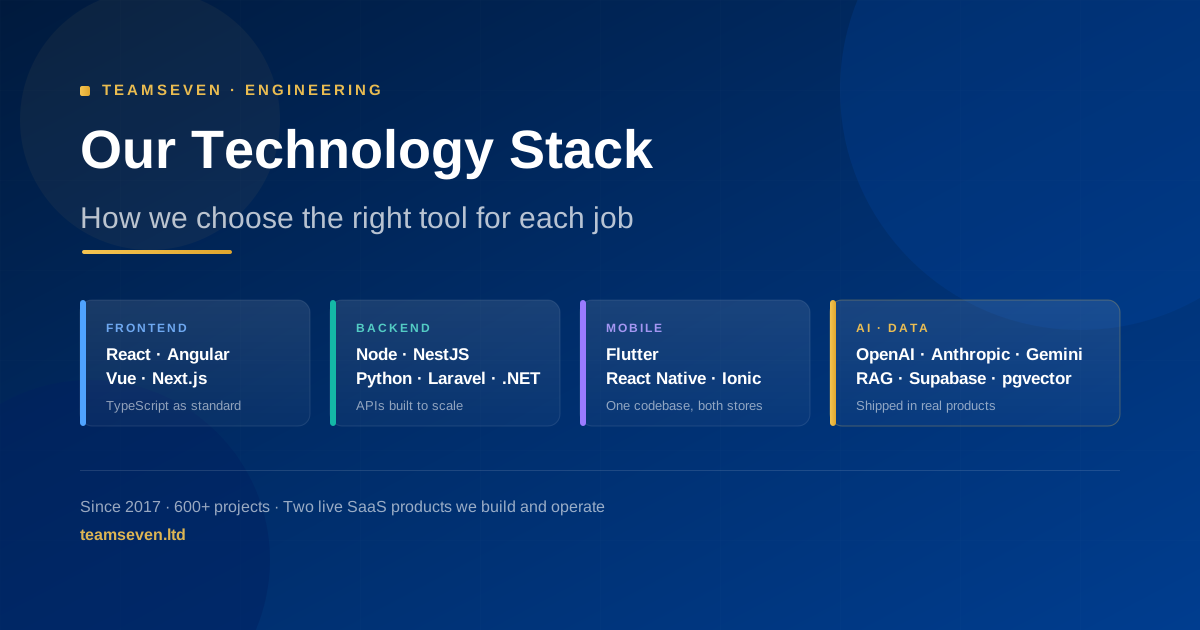
Node.js is our default for API-first, high-concurrency SaaS backends. Node's event-driven model handles thousands of simultaneous connections efficiently, and when the frontend is already JavaScript, one language across the stack means shared validation logic and less context-switching. We default to TypeScript on every Node project. The honest limit: Node excels at I/O-bound work, not CPU-heavy computation: for number-crunching we'd point you elsewhere.
Node rarely runs bare. For larger backends where multiple developers share the codebase, we reach for NestJS. It brings Angular-style structure, dependency injection, and built-in Swagger docs to Node, and that structure is what keeps a backend coherent at month twelve. For lean APIs and gateways where we want full control and minimal overhead, we use Express.js, typed with TypeScript, validated with Zod, documented with Swagger. Express imposes no structure, which is exactly why you use it: you get the structure you design.
Python is our pick when the backend problem is really a data problem, an automation problem, or an AI problem. Django when you want batteries included: auth, admin, ORM, forms; FastAPI when you need a high-performance API service with automatic OpenAPI docs. Python is the native language of the AI ecosystem (OpenAI, LangChain, Hugging Face, LlamaIndex are all Python-first) so for anything AI-heavy it removes a translation layer that other stacks carry. It's also where most of our data-pipeline work lives: moving customer data out of operational databases, cleaning it, and loading it into a data warehouse that analytics and AI-powered features can query without slowing down production. It's not the fastest runtime, and we'll say so; we choose it for developer velocity and data handling, not raw throughput.
PHP carries an old stigma and a modern reality. PHP 8.x has typed properties, enums, fibers, and match expressions. It's a modern language with an unmatched production record. Most PHP work today means Laravel: multi-tenant SaaS with subscription billing via Cashier, clean JSON APIs with Sanctum and API resources, and background job systems with Horizon. Laravel's complete ecosystem means less time assembling libraries and more time building features that matter.
.NET is where we go when correctness is non-negotiable: complex business logic, financial calculations, compliance-heavy workflows. Static typing plus mature enterprise tooling catches an entire class of errors that scripting languages miss, and ASP.NET Core's throughput is among the fastest, not a marketing line. When the cost of a wrong answer is high, that type system earns its keep.
Frontend: the interface is the product
React is what we use when your team or codebase is already on React, especially for anything behind authentication: dashboards, portals, admin tools. The ecosystem has matured to the point where almost every frontend problem has a well-maintained solution; the skill is knowing which libraries to pick and which to avoid. Component reuse has cut frontend build time 30–40% on our larger projects. TypeScript on every React project, always.
Angular is our default for enterprise complexity: multi-module platforms, large teams, role-based access, audit trails. Angular's opinionated structure is a feature, not a constraint: dependency injection, reactive forms, HTTP interceptors, and route guards ship in the box, and code written six months in looks like code written on day one. Angular 19 adds signals for fine-grained reactivity. For a small project that structure is overhead; for an enterprise application it's what keeps the codebase readable at month eighteen. This very site runs on Angular 19 with SSR.
Vue.js is our pick where simplicity is the point: data-rich interfaces without the heavier framework overhead, or a Laravel backend paired with Vue via Inertia.js for a full-stack approach in one repo, one team, one deployment.
Next.js is the answer when a React app can't afford slow first loads: public-facing SaaS sites, pricing and feature pages, editorial and content platforms where SEO drives acquisition. It gives you React's development experience with server-rendered, indexable HTML and ISR to keep content fresh without full rebuilds. The rule we apply: plain React behind auth (no SSR overhead for content nobody indexes), Next.js for anything the search engines need to read.
TypeScript isn't a framework. It's the correctness layer under all of the above. Typed props and hooks on the frontend, typed request/response objects and database queries on the backend, and shared interfaces that enforce the API contract between them at compile time. It's our default on every project, frontend and backend, because refactoring typed code is dramatically safer than refactoring plain JavaScript.
Mobile: one codebase, both stores
Flutter compiles to native ARM code and renders pixel-perfect UI on every platform. It's native-quality, not "good enough" cross-platform. We use it for consumer B2C apps shipped to both stores from one codebase, and for offline-capable field apps that sync with a web platform.
React Native is the right call for teams that already live in JavaScript. If you have a React web app and a JS team, adding mobile doesn't mean starting over. You share business logic, API calls, and type definitions across web and mobile. We've shipped React Native apps to both stores for logistics, healthcare, and e-commerce clients. The choice between Flutter and React Native usually comes down to your existing team, not the frameworks themselves, a decision we broke down in detail in Flutter vs React Native.
Ionic fits web teams that need mobile reach without a separate native track. Ionic plus Capacitor gives web developers native device access (camera, GPS, push, biometrics) and shines for PWAs that install on the home screen and internal corporate apps distributed without app-store overhead.
AI: the model is 20% of the work
This is the part of the stack we're most careful about, because it's where the gap between a demo and a production feature is widest.
AI integration is a systems engineering problem, not a model-selection exercise. We've shipped AI into products that generate revenue and cut operational cost, Tully AI and Mebag among them, and the lesson is consistent: the model is 20% of the work; the other 80% is latency, cost control, accuracy, and reliability under load. Successful AI adoption also depends on data readiness: an AI-powered feature is only as good as the customer data feeding it, which is why the retrieval layer usually pulls from a clean data warehouse rather than querying live tables directly. We match the model to the task rather than defaulting to the most expensive one, a stronger model for complex reasoning, cheaper models for classification and routing. We prefer RAG over fine-tuning for most domain-specific use cases because it's cheaper to run and far easier to keep current. And we build evaluation datasets, token budgeting, per-user cost tracking, and hard limits from day one, so a model update can't silently break quality and usage can't produce a surprise bill.
OpenAI integration specifically (GPT-4-class reasoning, the Assistants API for multi-step conversations, and RAG pipelines with proper streaming, error handling, and fallbacks) is where a lot of that work lands, and we handle hallucinations with structured outputs, validation, confidence scoring, and graceful fallbacks rather than hope.
Supabase deserves a place here because so many AI and MVP builds run on it. It isn't Firebase with a SQL veneer. It's real Postgres with auth, storage, and real-time wrapped around it, which means full SQL, transactions, Row Level Security for multi-tenant isolation, and the pgvector extension for building RAG and semantic search without a separate vector database. We reach for it when speed to market is the priority (MVPs and SaaS products where it eliminates the infrastructure setup that usually eats the first sprint) and because it's real Postgres underneath, you can migrate off it later if you outgrow it.
Choosing the right stack for your project
None of these is a default answer. They're answers to different questions. A high-concurrency SaaS API and a compliance-heavy financial backend want different runtimes. A JavaScript team and a design-led B2C launch want different mobile frameworks. A product that lives behind a login and a marketing site that has to rank want different rendering models.
Compressed into a table, here's how we'd match a technology stack to the shape of the problem:
| If your project is | We'd reach for | Because |
|---|---|---|
| API-first, high-concurrency SaaS | Node.js + NestJS | Event-driven I/O, one language across the stack, structure that survives a growing team |
| Data-heavy, automation or AI | Python (Django/FastAPI) | Native language of the AI ecosystem, strongest data tooling |
| Compliance-heavy or financial | .NET | Static typing plus mature enterprise tooling catches a whole class of errors |
| Multi-tenant SaaS with billing | Laravel | Cashier, Sanctum and Horizon cover subscriptions, API auth and jobs out of the box |
| Dashboard or portal behind login | React | Mature ecosystem, no SSR overhead for pages nobody indexes |
| Enterprise platform, large team | Angular | Opinionated structure keeps month-eighteen code readable |
| Public site where SEO drives growth | Next.js | Server-rendered indexable HTML with React's developer experience |
| Consumer app on both stores | Flutter | Compiles to native ARM, pixel-perfect on both platforms from one codebase |
| Mobile app with an existing JS team | React Native | Shares business logic, API calls and types with your web app |
| MVP that needs to ship fast | Supabase | Real Postgres with auth, storage, realtime and pgvector, minus the setup sprint |
The value of working with a team that ships across all of them, and runs its own products on several, is that we've paid for the wrong choice before and won't hand you ours. If you know the shape of your problem, we can usually name the right stack in a first conversation. If you don't yet, that's the conversation to have.
If you're weighing options for a specific build, book a free consultation and tell us the shape of the problem: workload, team, timeline. We'll tell you which of these we'd reach for, and which we wouldn't.
FAQ
How do I choose a technology stack for my project? Answer three questions before comparing frameworks. What's the shape of the workload: I/O-bound, CPU-heavy, data processing, real-time, or content-and-SEO? What do your team's existing skills and your timeline allow? And what will maintenance look like in eighteen months? Those three settle most stack decisions before anyone writes code.
Should I use Node.js or Python for my backend? Use Node.js when the work is I/O-bound and high-concurrency: API-first SaaS backends serving many simultaneous connections, especially when your frontend is already JavaScript. Use Python when the backend problem is really a data problem, an automation problem, or an AI problem, since Python is the native language of the AI ecosystem.
Is React or Angular better for my web application? Neither is better in general; they suit different projects. React fits most application frontends behind authentication (dashboards, portals, admin tools) with a mature ecosystem and lighter structure. Angular fits enterprise complexity: multi-module platforms, large teams, role-based access and audit trails, where its opinionated structure keeps a large codebase readable over time.
When should I use Next.js instead of plain React? Use Next.js when search engines need to read your pages: public-facing SaaS sites, pricing and feature pages, editorial and content platforms where SEO drives acquisition. Use plain React behind authentication, where server-side rendering adds overhead for content nobody indexes.
Should I choose Flutter or React Native for a mobile app? The choice usually comes down to your existing team rather than the frameworks. React Native is the right call if you already have a React web app and a JavaScript team, because you share business logic, API calls and type definitions across web and mobile. Flutter suits consumer B2C apps needing pixel-perfect UI on both stores from a single codebase.
Does the technology stack affect what a project costs? Less than most people expect at build time, and more than most expect afterwards. The larger cost difference comes from maintenance: a stack your team can hire for and reason about eighteen months later costs far less over three years than one chosen for benchmark performance alone.
How does the stack affect AI adoption later? It decides how much groundwork an AI-powered feature needs. If customer data already flows into a data warehouse and your backend is in Python or has clean APIs, adding retrieval-augmented generation or an AI-powered workflow is a small project. If data is locked in inconsistent operational tables, the long term cost of AI adoption is a data-engineering effort before any model work begins, which is why we factor AI readiness into stack choices even when AI isn't in the first release.
Related reading
Stay connected
Build notes, launches, and new articles from the Teamseven team.