Removals & Moving Company Software: The Complete 2026 Guide (From the Team Behind i-mve)
What software a removals company needs in 2026: off-the-shelf options, what they miss, and the case for custom, from the team behind i-mve.

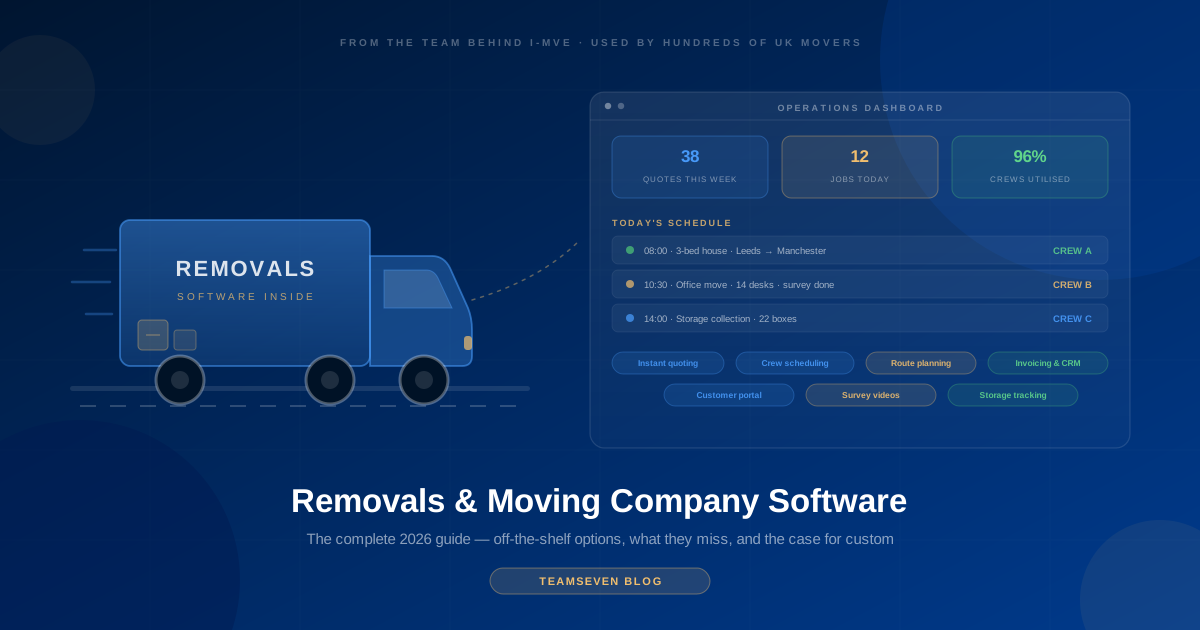
A removals company in 2026 needs software that covers seven jobs: enquiry capture, surveys, quoting, job & crew scheduling, customer communication, storage management, and invoicing. Off-the-shelf tools cover pieces; the operational wins come when those seven stop being seven systems. We have an unusual vantage point on this: Teamseven built and maintains i-mve, the platform that 523 UK removals companies run their operations on. This guide is what we've learned about the industry's software problem: written for the owner or ops manager trying to escape the whiteboard.
This guide is organised around the jobs the software has to do.
The whiteboard problem
Walk into a typical independent removals firm and you'll find the same stack: a diary or whiteboard for the schedule, a quoting spreadsheet only one person understands, WhatsApp threads with crews, a separate storage ledger, and Xero receiving manually retyped invoices. Each piece works. The gaps between them are where the money leaks:
- An enquiry answered six hours late goes to the competitor who answered in ten minutes: in a trade where the first professional quote wins disproportionately often.
- A surveyor's volume estimate lives in their notebook; the quote gets built from memory; the margin discovers the difference on move day.
- A crew turns up to a fourth-floor flat with no lift, because that detail lived in an email nobody attached to the job.
- Storage billing relies on someone remembering. Someone doesn't, some months.
None of these are people problems. They're data-handoff problems, and software is how you delete handoffs.
The seven jobs, and what "good" looks like
| Job | What good looks like in 2026 |
|---|---|
| Enquiry capture | Website forms, calls, and portal leads land in one inbox with status tracking: nothing lives only in someone's email |
| Surveys | Digital surveys (on-site or video) producing volume/inventory data that flows directly into the quote |
| Quoting | Price built from cubic volume, distance, access, crew size, and date: consistent across whoever quotes, branded, sent same-day, acceptable online |
| Scheduling | Jobs, crews, and vehicles on one calendar; conflicts visible before they happen; crew sees their day on their phone |
| Customer comms | Automated confirmations, reminders, and move-day updates: the professionalism customers quietly judge you on |
| Storage | Containers/units tied to customers with recurring billing that invoices itself |
| Invoicing | Generated from the job record, synced to Xero/QuickBooks, deposits and balances tracked |
The pattern worth noticing: every job consumes data from the previous one. Volume drives the quote; the quote becomes the job; the job becomes the invoice. That chain is the entire argument for an integrated platform: generic tools each hold one link and drop the chain.
Your three options in 2026
1. The generic stack (CRM + calendar + spreadsheets). HubSpot or a generic CRM, Google Calendar, Xero, and willpower. Cheapest on paper, and it's exactly the orbiting-spreadsheets pattern: the workflow lives in the gaps, in someone's head. Fine at low volume; the ceiling arrives with growth or staff turnover.
2. Industry software off the shelf. Removals-specific platforms exist (MoveMan, Moneypenny/RemovalsManager-style tools in the UK and equivalents elsewhere), and for many firms they're a sensible step up: the seven jobs in one place, priced per user or per branch. Where they pinch, in the conversations we have: your pricing logic doesn't fit their quoting model, multi-branch or franchise structures strain the permissions, the customer-facing experience is dated, integrations are a fixed menu, and the roadmap is theirs, not yours. You're renting the industry-average workflow.
3. A platform shaped like your operation. This is the i-mve story. The reason it serves 523 companies isn't feature count. It's that the data model matches how removals works: enquiry → survey → quote → job → crew → storage → invoice as one record's lifecycle, multi-tenant from day one so every company gets its own secure space on shared infrastructure (the architecture decision explained here). For an individual firm, the equivalent question is whether your scale or your edge justifies owning the workflow, our build-vs-buy scoring framework applies directly, and below a certain turnover threshold the honest answer is usually option 2.
What's changed for 2026: the AI layer
The newest gap between leaders and laggards in this trade is response speed and admin load, and AI moved both:
- Enquiry handling: drafted replies and quote follow-ups generated from the enquiry details, approved by a human in seconds rather than written in minutes. First-responder advantage, industrialized.
- Survey-to-inventory: extraction of item lists from video surveys and photos is now usable: volume estimates without the second site visit.
- Review and reputation: post-move review requests timed and personalized automatically: compounding exactly the local-search visibility that wins the next enquiry.
The integration pattern that works is the one we described in our AI roadmap for B2B platforms: AI drafts, humans approve, everything logged.
Buying checklist (whichever option you choose)
- Does survey data flow into the quote without retyping?
- Can it model your pricing: including the weird rules that make you money?
- Crew mobile view: usable in a van, offline-tolerant?
- Storage billing: recurring, or "recurring" with manual steps?
- Xero/QuickBooks sync: native or "via Zapier" (read: another subscription and another gap)?
- Multi-branch permissions, if that's your future?
- Who owns your data, and what does export look like the day you leave?
That last one is non-negotiable. Your job history, customer base, and pricing data are the most valuable asset your firm owns after the trucks. Any vendor who makes leaving hard is answering question seven for you.
FAQ
What does removals software cost in 2026? Off-the-shelf industry tools are priced monthly by users and modules, and vary a fair amount between providers. A custom operations platform for an established multi-branch firm follows the same custom CRM cost tiers we use elsewhere: a focused build sits at the lower end of that range. Most independents should start off-the-shelf and let the workarounds tell them when they've outgrown it.
We're a 3-truck firm. Do we need any of this? You need jobs one through four done consistently, even if it's the cheapest tool on the market. The firms that grow past three trucks are almost always the ones that stopped quoting from memory first.
Can software really help us win more jobs, or just save admin? Both, but the winning mechanism is specific: same-day professional quotes and instant enquiry response. In a trade where most firms reply within "a few days," responding in ten minutes is a conversion strategy disguised as software.
You built i-mve: can you build something for our company? i-mve is its own platform with its own owner, and we don't share or reuse client IP: ever; it's contractual. What we bring to a new engagement is eight years of domain understanding of how removals operations flow. If you're a software founder eyeing the logistics vertical, or an operator who's outgrown the off-the-shelf menu, that's a conversation we're well equipped for.
Building software for the moving and logistics industry, or running a firm that's outgrown its whiteboard? Book a free 30-minute scoping call. Few teams know this vertical's workflows better.
Stay connected
Build notes, launches, and new articles from the Teamseven team.