Bespoke Software Development UK: What It Actually Means and When You Need It
Bespoke software development UK guide — what it means, when it beats off-the-shelf, 2026 cost ranges, and how to choose a UK development partner.
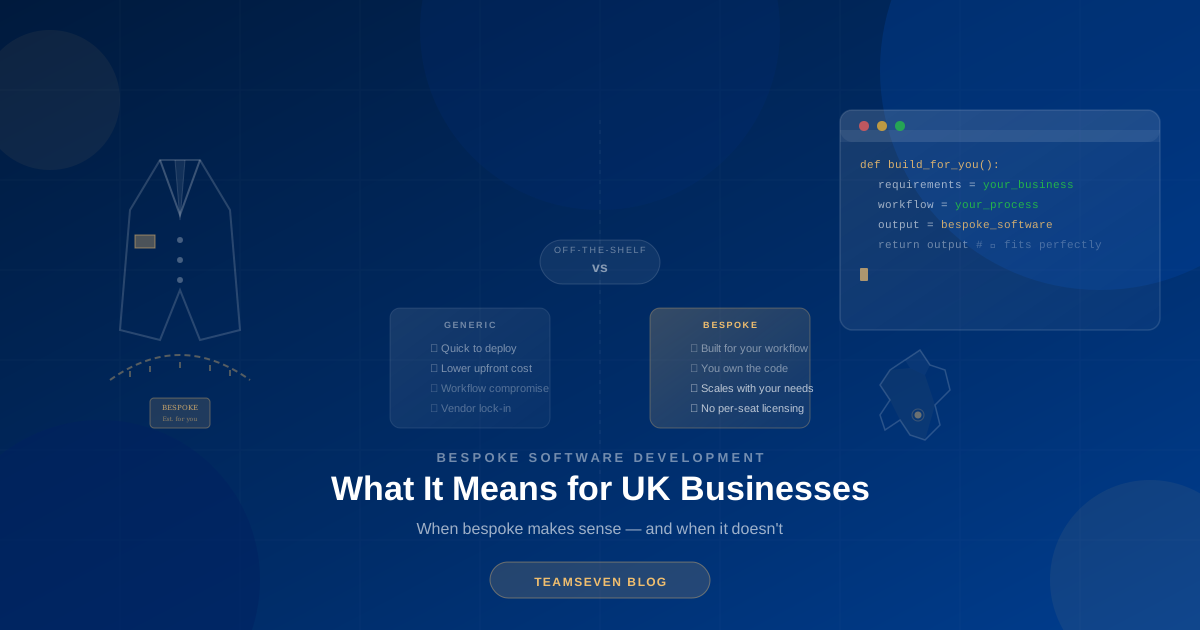
If you're a UK business owner researching software development options, you've probably encountered both terms: "bespoke software" and "custom software." They mean the same thing. "Bespoke" is simply the term more commonly used in British English — borrowed from the tailoring industry, where a bespoke suit is one cut specifically to your measurements rather than pulled off the rack.
The principle transfers directly to software. Bespoke software is built specifically for your business, your workflows, and your requirements — not adapted from a generic product that was built for the average company in your industry.
This post is a practical guide for UK business owners considering a bespoke software project. What it actually involves, when it makes sense, what it costs in 2026, and how to evaluate a software development partner. Whether you're scoping web platforms, internal tools, or mobile app development, the same principles apply — the decision is about fit, not fashion.
If you already know you need this built. Skip the explainer and see our bespoke software development UK services — what we build, what it costs, and the UK platforms we've shipped.
Why UK businesses use "bespoke" instead of "custom"
It's worth understanding the terminology, because it affects how you search for suppliers and how suppliers market themselves to you.
In the UK, "bespoke software development" is the dominant search term. UK development agencies, consultancies, and procurement professionals use it consistently. If you're putting out a tender or searching for suppliers, "bespoke software" will surface UK-relevant results more reliably than "custom software."
In the US and Australia, "custom software development" is the standard term. Same concept, different vocabulary.
Practically, if you're a UK business evaluating development agencies — including offshore agencies who serve UK clients — you should check that they understand the UK context, not just whether they use the right vocabulary. Any decent agency should be able to adapt to either term.
What bespoke software actually is
Bespoke software is any software application built specifically for one business or organisation, rather than sold as a generic product to many customers.
The opposite of bespoke software is off-the-shelf software (COTS — Commercial Off-The-Shelf). Sage, Salesforce, SAP, Microsoft Dynamics, Xero — these are products built for a broad market and adapted to individual customers through configuration and customisation.
Bespoke software sits on a spectrum. On one end is a completely bespoke system built from scratch. On the other is a heavily customised off-the-shelf product. Most real-world custom software projects sit somewhere in the middle — often a bespoke application that integrates with existing off-the-shelf tools.
The right bespoke software solutions are shaped by the same discipline regardless of where they land on that spectrum: proper requirements work, deliberate software engineering rather than copy-paste assembly, and a delivery process that survives contact with real users.
For UK businesses, common bespoke software projects include:
Operational management systems. Workflow management, job scheduling, resource allocation, and operational dashboards built around how a specific business actually runs — rather than how a generic software vendor thinks it should run.
CRM and client management platforms. Standard CRM tools like Salesforce and HubSpot are powerful but generic. Businesses with complex client relationships, unusual sales processes, or industry-specific requirements often find that a bespoke CRM — or a heavily customised integration layer on top of an existing CRM — serves them better.
Industry-specific platforms. Removals management software, legal case management, property management, healthcare scheduling, logistics coordination — industries with specific regulatory requirements and operational complexity often benefit from software built around their particular needs.
Internal tools and automation. Automating manual processes, connecting systems that don't talk to each other, building internal dashboards and reporting tools. Often less glamorous than a customer-facing product but with direct, measurable ROI.
Customer-facing portals. Client portals, customer dashboards, self-service tools. When off-the-shelf portal solutions don't match your service offering or your brand requirements.
When bespoke software makes sense for a UK business
The honest answer is: not always. Off-the-shelf software is genuinely excellent for many use cases, and the ecosystem of UK-relevant SaaS tools is broader and deeper than it's ever been.
Bespoke software makes sense when:
Your core processes don't fit standard software. If you're spending significant time working around your software — maintaining parallel spreadsheets, manually transferring data between systems, training staff on workarounds — that's the clearest signal that your operations have diverged from what standard software was built for.
Regulatory or compliance requirements are specific. UK businesses in financial services, healthcare, legal, and certain professional services have compliance requirements that generic software doesn't always address cleanly. Bespoke software can build compliance in by design rather than bolting it on.
You're building a software product for market. If your business idea is a software product you'll sell to other businesses or consumers, you're building bespoke software by definition. Off-the-shelf solutions can't be your product.
The ROI justifies it. Bespoke software has an upfront cost that off-the-shelf doesn't. The question is whether that cost is lower than the ongoing cost of working around software that doesn't fit — in staff time, errors, lost efficiency, and missed opportunities. When that calculation favours building, build.
You need genuine competitive differentiation. If your operational capability is a competitive advantage, standardising on the same software as your competitors is a strategic risk. Bespoke software can encode your specific approach in a way competitors can't easily replicate.
When bespoke software doesn't make sense
When off-the-shelf would genuinely work. Many UK businesses default to considering bespoke software because they've had bad experiences with off-the-shelf products — but often the right answer is finding better off-the-shelf software or investing in proper implementation, not building from scratch.
When your processes aren't defined yet. Bespoke software encodes your current processes in code. If those processes are still evolving, you're building something you'll need to rebuild. Define your operations, stabilise them, then build software around the stable version.
When budget is the constraint and the existing software is functional. Bespoke software is an investment. If cash is tight and your current software is functional, even if imperfect, optimising operations within existing constraints may be the right call.
When the project is for one simple function. A single automation, a simple reporting tool, a basic integration — these are often better solved with no-code tools, an integration platform like Zapier or Make, or a short development engagement than a full bespoke build.
What bespoke software development costs in the UK in 2026
Pricing varies significantly based on team location, project complexity, and scope. Rather than publish numbers that go stale and invite comparison shopping on a spreadsheet, here's an honest breakdown of what actually moves the price.
UK-based development agency: Senior UK developers carry the highest day rates in the market, driven by office overhead, salaries, and the London/South East cost base most agencies operate from. You're paying for full timezone overlap and local legal comfort alongside the engineering.
Eastern European agency: A meaningful step down in rate from UK-based teams, with strong timezone overlap (roughly 6–8 hours) and a mature outsourcing market with a long track record serving UK clients.
South Asian agency (including Pakistan): The lowest cost base of the three, for comparable seniority — the same reason our own rates sit where they do. Overlap with UK mornings is real but narrower (roughly 4–5 hours), which is where a well-run agency's process and communication habits matter most.
These are ranges for professional agencies delivering production-quality work — not freelancers on Upwork, and not body-shopping firms that provide developers without management or architecture support.
The right question isn't "how do I get this as cheap as possible?" It's "what's the total cost of ownership over 3 years?" A system built quickly and cheaply that requires expensive maintenance and breaks under load costs more than a system built properly at a sensible upfront cost.
Budget for the parts that aren't the build. On a typical UK bespoke project, ongoing costs land as a meaningful percentage of the original build cost every year once you add hosting, third-party licences, security patching, and the change requests that arrive the moment real users touch the system. Ask any agency you're evaluating to walk you through that first-year total, not just the build price.
A worked example of when the numbers justify a build
The ROI logic is straightforward even without attaching figures to it here. Take a UK services business where a meaningful share of operations staff lose real time each day to manual data entry and spreadsheet reconciliation between systems that don't talk to each other.
Multiply that lost time by a fully-loaded staff cost and by the number of people affected, and you get an annual figure — the cost of doing nothing. A bespoke build that removes most of that friction only makes sense if it pays for itself well inside its useful life, and keeps paying every year after.
Flip the same logic the other way and the answer can change fast. If only one or two people lose a small amount of time each day, the annual waste may be too small to justify a full build, however real the frustration feels day to day. Same business, same frustration, completely different decision. That calculation, not the strength of the frustration, is what should drive it — and it's exactly the kind of maths we'll run with you on a scoping call before you commit to anything.
Where you are in the UK matters less than you'd think
Procurement teams often start by searching for a supplier in their own city. For most projects that constraint costs more than it returns — you're selecting from a smaller pool at higher rates for on-site availability that a well-run remote engagement rarely needs.
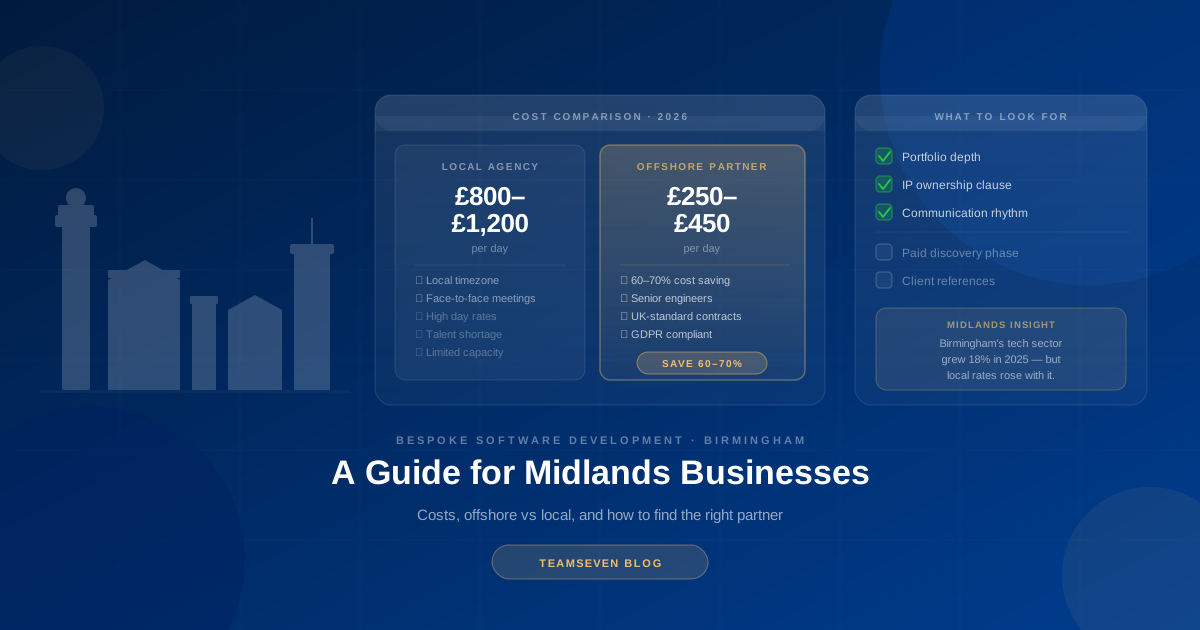
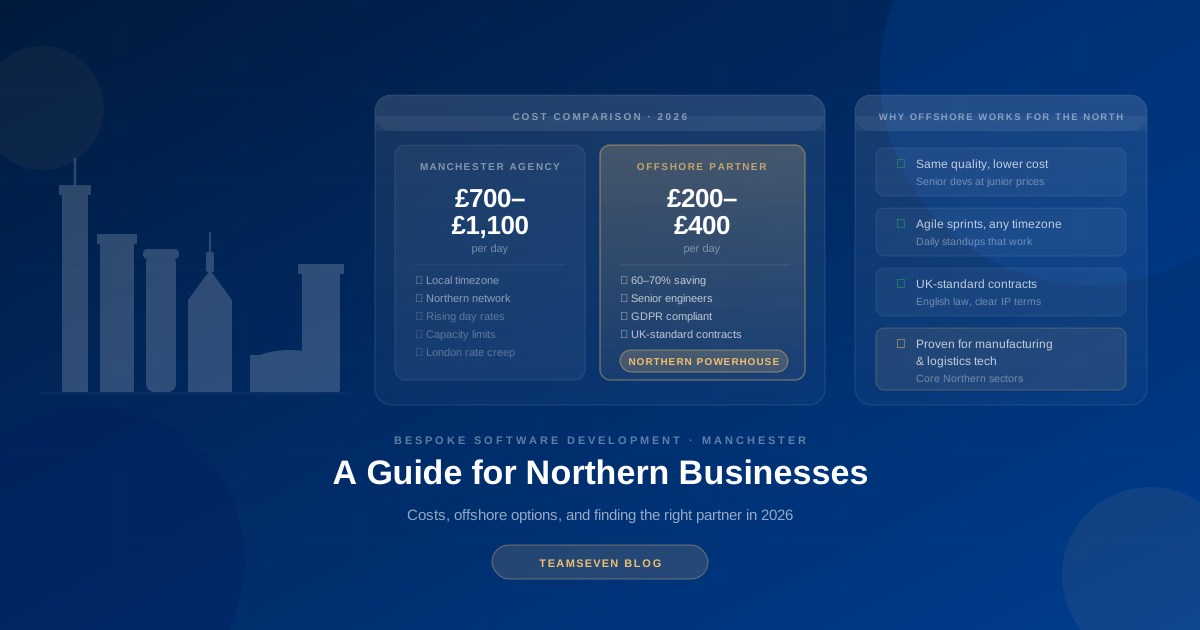
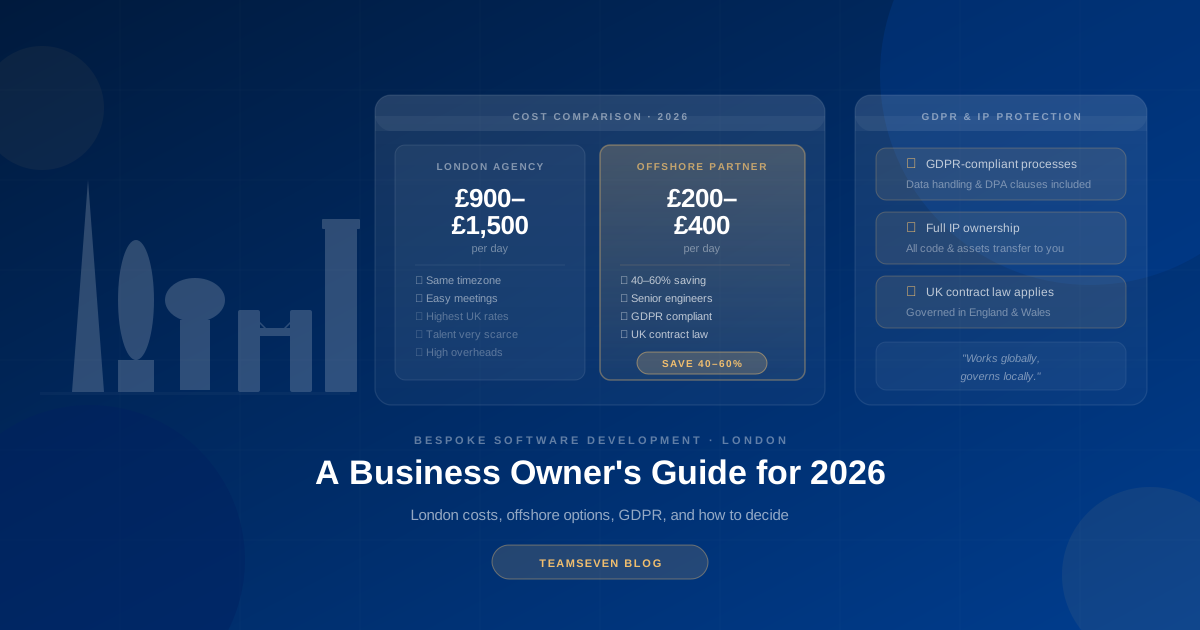
Where local presence genuinely helps is discovery workshops, stakeholder interviews across multiple sites, and regulated environments where someone must be physically present to access systems. If that describes your project, our bespoke software development London guide covers the London market specifically — rates, the talent pool, and when a London-based team is worth the premium. We've also written city guides for Manchester and Birmingham.
How to evaluate bespoke software development agencies
Finding the right development partner is harder than finding the right software product. A few things that actually matter when evaluating UK bespoke software agencies:
Verified client reviews. Clutch, GoodFirms, and TechBehemoths all have verified review systems — clients are interviewed directly by the platform, not just asked to leave a star rating. Prioritise verified reviews over testimonials on agency websites.
Relevant project portfolio. An agency with 50 e-commerce builds is not the same as an agency with experience in your industry. Look for genuine project similarity — same complexity level, same type of user base, same integration challenges.
Discovery process. Good agencies invest time in understanding your business before proposing a solution. If an agency quotes a fixed price within 48 hours of your requirements document without asking clarifying questions, they're guessing.
Architecture transparency. You should understand, at least at a high level, what technical decisions are being made and why. An agency that can't explain their architecture choices in plain English is either making poor decisions or hiding something.
Years of experience — and what it was spent on. A team's years of experience only counts if it was spent on software development projects that resemble yours in complexity and stakes. Ten years of brochure websites is not ten years of building operational platforms. Ask what the team has actually shipped and kept running.
Post-launch support. Bespoke software is not done at launch. Ask how the agency handles post-launch support — bug fixes, security patching, small enhancements, and the change requests that always arrive once real users touch the system. A good development partner treats the first months after go-live as part of the engagement, not an afterthought.
Contract clarity. IP assignment, payment milestones, change order process, support terms — every bespoke software contract should cover these unambiguously. If an agency is vague about IP ownership or change order pricing, that ambiguity will cost you money later.
GDPR and data handling. For UK businesses post-Brexit, data protection compliance is non-negotiable. Your development partner should be able to speak to GDPR requirements, data processing agreements, and how they handle UK client data.
Offshore bespoke software development for UK businesses
Many UK businesses work with offshore development agencies — primarily in Eastern Europe and South Asia. The UK is one of the most internationally-minded markets for software procurement, partly because of the talent shortage and high costs of UK-based development.
Working with an offshore agency for a bespoke project introduces challenges that domestic projects don't have:
Time zone management. Pakistan (GMT+5) has meaningful overlap with UK mornings. Eastern European agencies (GMT+1 to GMT+3) have excellent overlap. Southeast Asian agencies have almost none.
Communication overhead. Every communication that would take 30 seconds face-to-face takes longer across time zones and cultures. Good offshore agencies compensate with excellent written communication, detailed documentation, and regular video updates.
Contract and legal framework. Offshore contracts are governed by the agency's home jurisdiction unless explicitly specified otherwise. A well-drafted contract should specify governing law, dispute resolution, and IP jurisdiction clearly.
GDPR compliance. If you're passing personal data to an offshore developer, you need a Data Processing Agreement (DPA) regardless of the agency's location. Any reputable agency working with UK clients should understand this and provide appropriate documentation.
When offshore development works well for UK businesses, it works because the client invests in clear requirements, the agency invests in communication quality, and both parties treat the relationship as a long-term partnership rather than a transactional engagement.
A UK bespoke software project we delivered
One example of what bespoke software development looks like in practice for a UK client: we built i-mve — an all-in-one CRM and operations platform for UK removals and storage companies.
The removals industry in the UK had specific needs that no off-the-shelf CRM addressed properly: job scheduling, crew management, storage inventory tracking, UK-specific removal documentation, integrations with UK lead generation platforms (Compare My Move, PinLocal, Getamover), and accounting integrations with Xero, QuickBooks, and Sage.
We built the platform from scratch. It's now live and used by hundreds of removal companies across the UK. The product has its own website, its own pricing, its own customers. It's a fully functioning SaaS business that started as a bespoke development brief.
That's what the right bespoke software project can become.
Getting started with a bespoke software project
If you're a UK business considering a bespoke software project, here's how to approach it:
Define the problem before the solution. Write down what's actually wrong with your current situation — where staff time is wasted, where errors occur, where processes break down. The clearer your problem definition, the better the solutions you'll evaluate.
Set a realistic budget range. Don't go into conversations with agencies without a budget range in mind. "As cheap as possible" is not a useful brief. A realistic budget range helps agencies scope appropriately rather than proposing the expensive version by default.
Ask for a discovery engagement first. Before committing to a full build, ask agencies whether they offer a paid discovery phase — 2–4 weeks of requirements definition and architecture design. This surfaces misalignment before it costs you a full project budget.
Check references directly. Ask agencies for references from clients with similar project types to yours, and actually call those references. Clutch reviews are useful but a direct conversation with a past client is more revealing.
Don't choose on price alone. The cheapest bespoke software quote is almost never the best value. If you're choosing between quotes, understand why the prices differ — scope, team quality, process maturity — before deciding based on the number alone.
FAQ
What is bespoke software development? Bespoke software development is building an application specifically for one business's workflows and requirements, rather than buying a generic product sold to many customers. "Bespoke" is the British English term; "custom software development" means exactly the same thing and is the standard phrase in the US and Australia.
How much does bespoke software development cost in the UK? It depends heavily on team location, complexity, and scope — a UK-based agency's day rate sits well above an Eastern European or South Asian agency's for comparable seniority, and the gap compounds across a full project. Budget an additional ongoing percentage of the build cost per year for hosting, licences, security patching, and change requests. The only reliable way to get a real number is to scope the specific project — book a call and we'll give you one.
How long does a bespoke software project take? A mid-complexity bespoke application generally takes 16–32 weeks from kick-off to production, largely independent of where the team is based. A paid discovery phase of 2–4 weeks usually precedes that and is worth doing separately before you commit to a full build budget.
Is bespoke software better than off-the-shelf? Not automatically. Off-the-shelf wins when your processes are standard, your budget is constrained, and existing software is functional. Bespoke wins when your core processes don't fit standard tools, compliance requirements are specific, the software is the product you're selling, or the cost of working around bad-fit software exceeds the cost of building.
Who owns the code in a bespoke software project? You should, but only if the contract says so explicitly. In some jurisdictions a contractor retains rights to work they create unless IP is assigned in writing. Confirm IP assignment, repository ownership, and infrastructure account ownership contractually before work begins — ambiguity here can derail a future funding round or acquisition.
Can I use an offshore agency for a UK bespoke software project? Yes, and many UK businesses do. You need a Data Processing Agreement for GDPR regardless of the agency's location, a contract specifying governing law and IP jurisdiction, and meaningful timezone overlap. Pakistan at GMT+5 overlaps UK mornings; Eastern Europe overlaps nearly the full day; Southeast Asia has almost none.
Muhammad Nabeel is the co-founder of Teamseven, a bespoke software development agency based in Lahore, Pakistan. Our development services span web platforms, internal tooling, systems integration, and mobile app development. We've been building custom and bespoke software for UK businesses since 2017 — including i-mve, which is now live across the UK — with post-launch support carried through as part of every engagement. Get in touch to talk through your project.
Looking for a bespoke software partner in the UK?
If you've decided a bespoke build is the right move, our bespoke software development UK services page covers what we build, honest cost ranges, and the UK platforms we've delivered — including i-mve.
You can also read more about working with us from the UK — time zones, contracts, GDPR, and UK client examples: