AI Agents for Business: What We Learned Actually Building One
An experience-based guide to AI agents for business: what they really are, where they work, where they fail, and what they cost. From a team that ships them.

There is a lot of noise about AI agents right now, and most of it is written by people selling the dream rather than people who've shipped the thing. So let me offer the other perspective: what AI agents are once you strip the hype, where they work, where they fall over, and what it really costs to build one that does something useful.
We build AI products. Mebag, one of ours, uses AI to do real work: price prediction and recommendations, built on OpenAI. So this comes from having wired models into production software that real people use, not from a whitepaper.
What an AI agent is (minus the hype)
Strip away the marketing and an AI agent is software that can take a goal, decide on the steps to reach it, use tools to carry those steps out, and adjust based on the results, with less step-by-step human instruction than traditional software needs.
The key difference from a normal program: a traditional program follows the exact path you coded. An agent is given an objective and works out the path, calling tools (search, a database, an API, another system) as it goes. That flexibility is the appeal. It's also the source of most of the problems, which we'll get to.
What an agent is not: it's not magic, it's not reliable in the way deterministic software is, and it's not a replacement for understanding your own business process. An agent that automates a broken process just breaks things faster.
Where AI agents work
From building with this technology, the pattern is clear: agents shine where the task involves language, judgment on messy inputs, or synthesis, and where being occasionally wrong is tolerable.
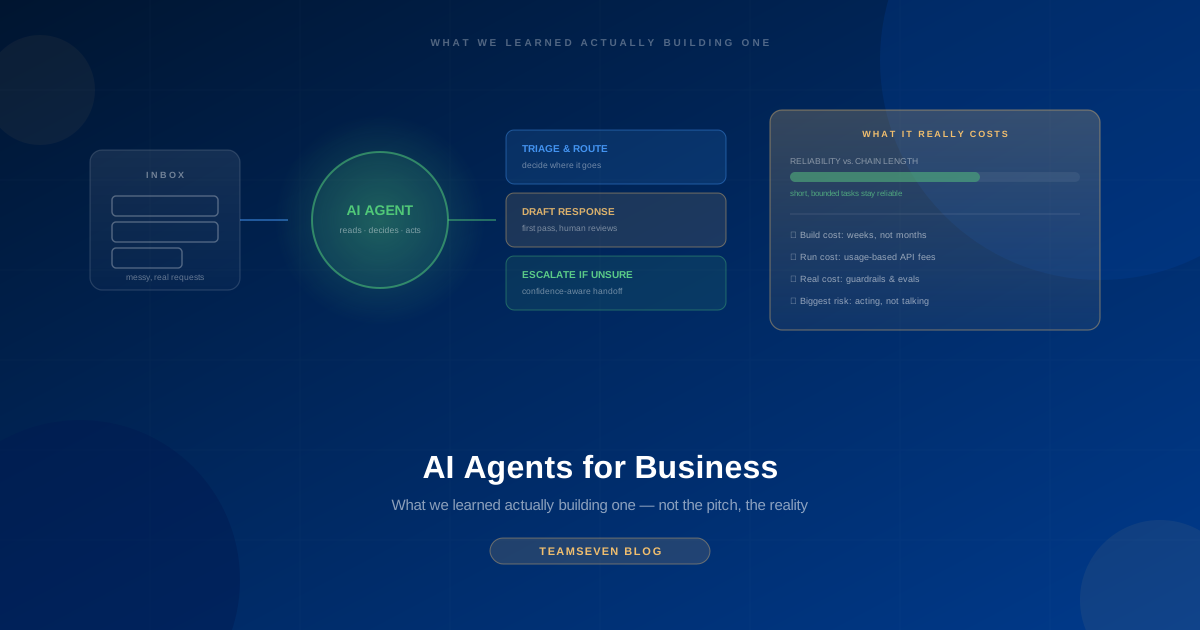
Strong fits: summarising and drafting (support replies, reports, first drafts), triaging and routing (reading an incoming request and deciding where it goes), extracting structure from mess (pulling data out of unstructured documents or emails), research and synthesis (gathering and condensing information), and customer-facing assistance for common questions.
The common thread: these are tasks a capable junior human could do, where language and judgment matter, and where a mistake is annoying rather than catastrophic. That's the agent sweet spot.
Where AI agents fall over
This is the part the hype skips, and it's the part that matters most if you're spending real money.
Anything requiring perfect accuracy. Agents are probabilistic. They're usually right, occasionally confidently wrong. For tasks where being wrong is unacceptable (moving money, medical decisions, legal commitments, anything irreversible) an agent alone is the wrong tool. You need deterministic logic, or a human check, or both.
Long chains of dependent steps. An agent that takes ten steps where each depends on the last will compound its errors. A small mistake at step three quietly corrupts steps four through ten. The more autonomous and multi-step the task, the more the reliability degrades. Short, bounded tasks work far better than long autonomous chains.
Anything where the cost of a wrong action is high. An agent that can take actions (send emails, make changes, spend money) is more useful and more dangerous than one that only suggests. Give an agent the ability to act, and you've also given it the ability to act wrongly, at scale, quickly. Guardrails aren't optional here.
When the process itself isn't understood. If you can't clearly describe the task a human does, an agent won't magically figure it out. Vague goals produce vague, unreliable behaviour.
The lessons that matter
The AI is a component, not the product. This is the single most important thing we've learned building AI software. The model is one part of a system that's mostly normal engineering: data pipelines, validation, error handling, the boring reliable stuff. Teams that treat the AI as the whole product underbuild everything around it, and it shows. In Mebag, the AI does the hard prediction; solid conventional code does everything else. That ratio is healthy.
Validation and guardrails are the real work. Because agents can be confidently wrong, the engineering that matters is what checks their output before it reaches a user or triggers an action. Sanity checks, confidence thresholds, human-in-the-loop for high-stakes steps, fallbacks when the model is uncertain. This is most of the serious engineering in a real AI product.
Costs scale with usage, and they sneak up. Every agent action is an API call, and API calls cost money that grows directly with how much you use it. Success makes your bill bigger. Cost control (caching, batching, using cheaper models where they suffice, monitoring spend in real time) is a discipline you build in from day one, or you learn it painfully later.
Honesty about uncertainty builds trust. An agent that says "I think this is likely, but check it" is more trustworthy and more useful than one that presents every guess as fact. Design the product to be truthful about what it doesn't know.
What it costs to build a business AI agent
| Scope | What drives the cost | Timeline |
|---|---|---|
| AI feature/agent added to existing software | One integration, existing product surface | 6–12 weeks |
| Standalone agent for a defined business task | New build around one well-scoped task | 12–24 weeks |
| Full AI-powered product (multiple capabilities, integrations) | Multiple agent capabilities, several integrations | 24–40 weeks |
On top of the build, remember the operational cost: the ongoing API spend that scales with usage. A cheap build with runaway API costs isn't cheap. We'll walk through both on a scoping call, once we know what you're building.
Related reading
Should you build an AI agent?
Most businesses adding "an AI agent" would get more value from being specific about the one task they want help with than from chasing the trend.
Build one when you have a specific, language-or-judgment-heavy task, done often, where occasional errors are tolerable and the value of automating it is real. That's a genuine fit and it can pay back quickly.
Don't build one when you're adding AI because it's fashionable, when the task needs perfect accuracy, when a few business rules would do the job more reliably and cheaper, or when you can't clearly describe the process you're trying to automate. Not everything benefits from a probabilistic answer.
The question I ask every client who wants "an AI agent": what specific job is it doing, and would a non-AI solution do it better? If they can answer the first part crisply, we're in business. If they can't, they're chasing a buzzword, and I'll tell them so, even though we're the ones who'd build it.
"The AI is a component, not the product. The model is one part of a system that's mostly normal engineering."
Stay connected
Build notes, launches, and new articles from the Teamseven team.