
Building a GDPR-Compliant Healthcare SaaS for the German Market: How We Built Rezi24
What it takes to build healthcare software for German practices: GDPR by design, German hosting, and an online reception non-technical teams can run.

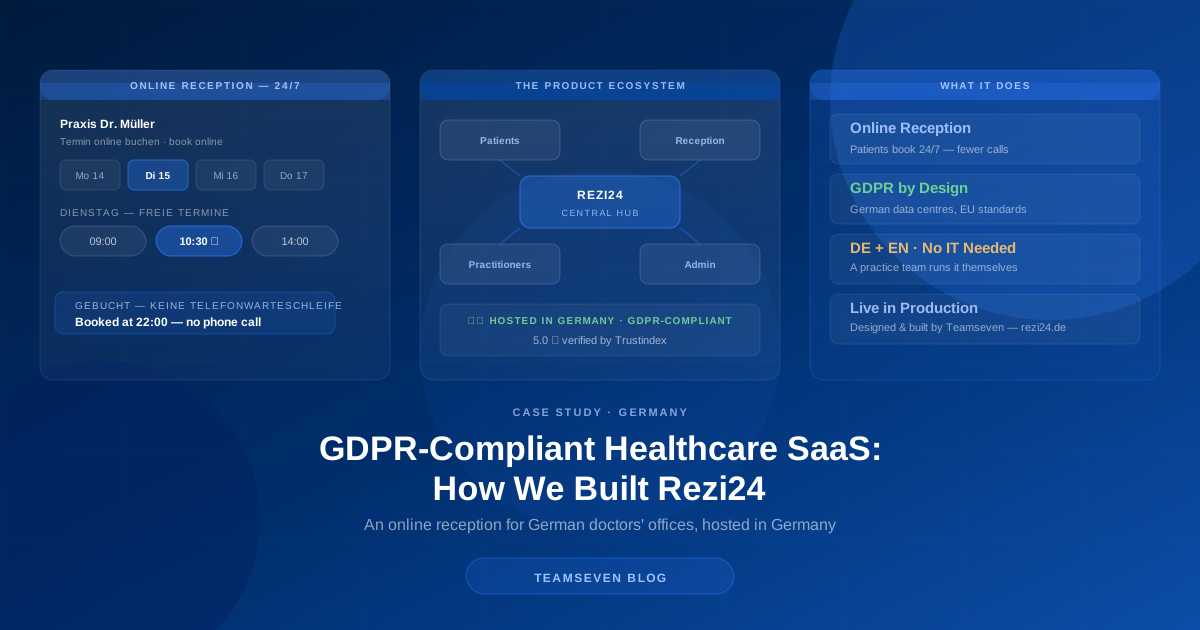
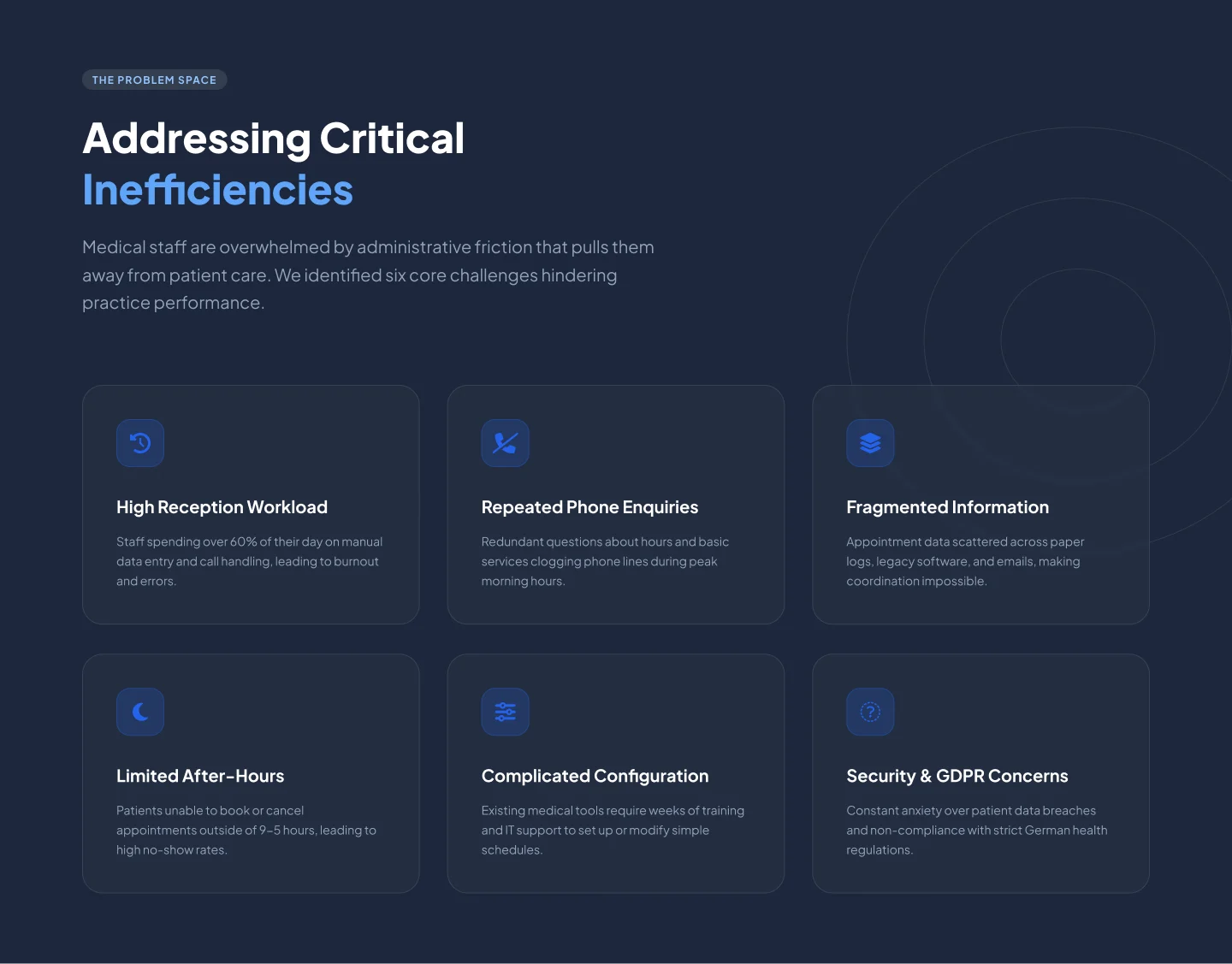
Walk into the reception of a busy German medical practice at ten in the morning and you'll see the same scene play out that plays out in thousands of practices across the country. The phone rings without stopping. One staff member is rescheduling an appointment while two more calls stack up in the queue and a patient stands at the desk, waiting. The reception team spends more of its day coordinating access to the practice than doing anything else, and almost every one of those calls is a routine question that never needed a person: what are your hours, can I move my appointment, do you have anything this week.
That's the scene Rezi24 was built to change. Rezi24 is an online reception for modern doctors' offices, hosted in Germany and built to GDPR and EU data-protection standards, that we designed and built for the German market at rezi24.de. It was also our first engagement in the EU, and building healthcare software to German standards taught us things about compliance-by-design that a checklist never could. This is the honest story: what the German market demands, why we started with data protection instead of features, and how we shipped something a non-technical practice team can run themselves.
The platform was built and launched in full: the engagement itself is currently on hold, and the client hasn't been actively marketing it since. What follows is the technical and product story of what we built, not a claim that it's being actively promoted today.
What is "online reception" software?
Online reception software gives a medical practice a digital front desk: patients book, reschedule, and enquire online, around the clock, while the practice manages appointments, locations, treatments, and patient communication from one dashboard. It sits between the patient and the practice and absorbs the routine coordination that would otherwise arrive as phone calls.
The phrase "online reception" matters more than "booking tool," because the goal isn't only to take bookings. It's to let a patient do online everything they'd otherwise phone in for, so the reception team is freed for the work that needs a human. A booking widget bolted onto a website doesn't do that. A connected system that patients, reception staff, and practitioners all live inside does.
Why we started with data protection, not features
In most healthcare software projects, compliance is a constraint you design around. In Germany, it's the ground you build on. Patient data is among the most strictly protected categories of information under the GDPR, and German practices carry a constant, entirely rational anxiety about breaches and non-compliance. So the very first architectural decisions on Rezi24 weren't about screens. They were about where data lives, how it's protected, and who can reach it.
The answer we committed to: hosted in Germany, on German data centres, designed to GDPR and EU data-protection standards, with patient data treated as a protected category from the first line of code. "Made in Germany, hosted in Germany, GDPR-compliant" is not a marketing line stapled on at the end. It's a set of engineering constraints that shaped the whole system. This is the same principle we've argued in how we approach clinical software: you cannot retrofit a compliance posture after the fact, because the data model, the hosting, and the access rules all have to be right before the first real patient record exists. Get that order wrong and you don't have a bug, you have a system you have to rebuild.
For a foreign development partner, the German market is a real test of this. It's not enough to be technically competent; you have to understand which standard applies and design to it deliberately. That's exactly the discipline we bring to regulated software. We're not a certification body and we don't issue compliance sign-off: what we can say plainly is that we hosted the platform in Germany and built the data model, access rules, and encryption around GDPR and EU data-protection standards from day one.
The product is an ecosystem, not a booking page
The mistake we were determined not to make was building a booking widget and calling it a platform. Rezi24 is designed as a connected ecosystem with the platform as the central hub between four groups: patients booking from the public website and digital reception, the reception team fielding and coordinating requests, the medical provider dashboard where practitioners run their day, and account administration. Data and interactions flow between all four, so a booking a patient makes at ten at night is simply there in the practice's schedule the next morning: no phone call, no transcription, no double entry.
On the patient side, we built a public practice website with an online reception: patients book appointments themselves, at any hour, regardless of opening times, from a page that reflects the practice's own branding. That single capability removes the largest source of routine phone traffic in one move.
On the practice side, the provider dashboard covers the real operating surface of a medical office: services and treatments, multiple locations and departments, patient management, an internal chat for coordinating between staff, feedback, and practice news. It's the difference between a tool that takes bookings and a system a practice runs on. Designing that flow of data cleanly between roles is the core of multi-tenant SaaS architecture, where each practice is its own isolated tenant with its own data, branding, and configuration.
Building for non-technical users is a feature, not an afterthought
Here's the constraint that quietly shaped everything: the practices Rezi24 serves are not technical. A reception team does not have an IT department, and a solution that takes weeks of training and IT support to set up or modify a simple schedule is a solution they will never adopt. Existing medical tools ask exactly that, and lose.
So the entire configuration experience was designed to be operated by a practice manager, not an implementation consultant. Site customisation, departments, appointment types, availability, treatments: all managed through a structured admin interface, no scripting, no developer access, no support ticket to change a Tuesday's hours. Security-sensitive actions are protected with two-factor authentication, and the whole interface ships in both German and English.
We also designed the relationship around non-technical users, not just the UI. Rezi24's own team stays involved after launch (helping with setup and continuing to assist with adjustments, new processes, and short-notice changes) so the practice never has to worry about the technical side. That "we handle the technical part for you" promise is only credible if the software underneath is simple to operate, which is why the two had to be designed together. Choosing what to make configurable versus what to keep out of a non-technical user's way is one of the hardest and most underrated parts of building a SaaS product.
Tiered plans, because a solo practice isn't a clinic group
A single-practitioner office and a multi-location group have different needs, and pricing them the same gets you no customers at either end. Rezi24 is offered in tiers (a Core plan for solo and small practices, an All Round plan for growing practices with multiple locations, and an Enterprise tier for larger groups) so a practice pays for the capacity and features it uses.
That tiering isn't only a commercial decision; it's an architectural one. Multi-location support, unlimited departments, team access, and role allocation have to be built as capabilities the system can switch on per tenant, cleanly, without a separate codebase per plan. Getting that right at the data layer early is far cheaper than bolting it on once you have paying practices on the smallest plan: a lesson that applies to every SaaS platform we build.
The trust signals German healthcare responds to
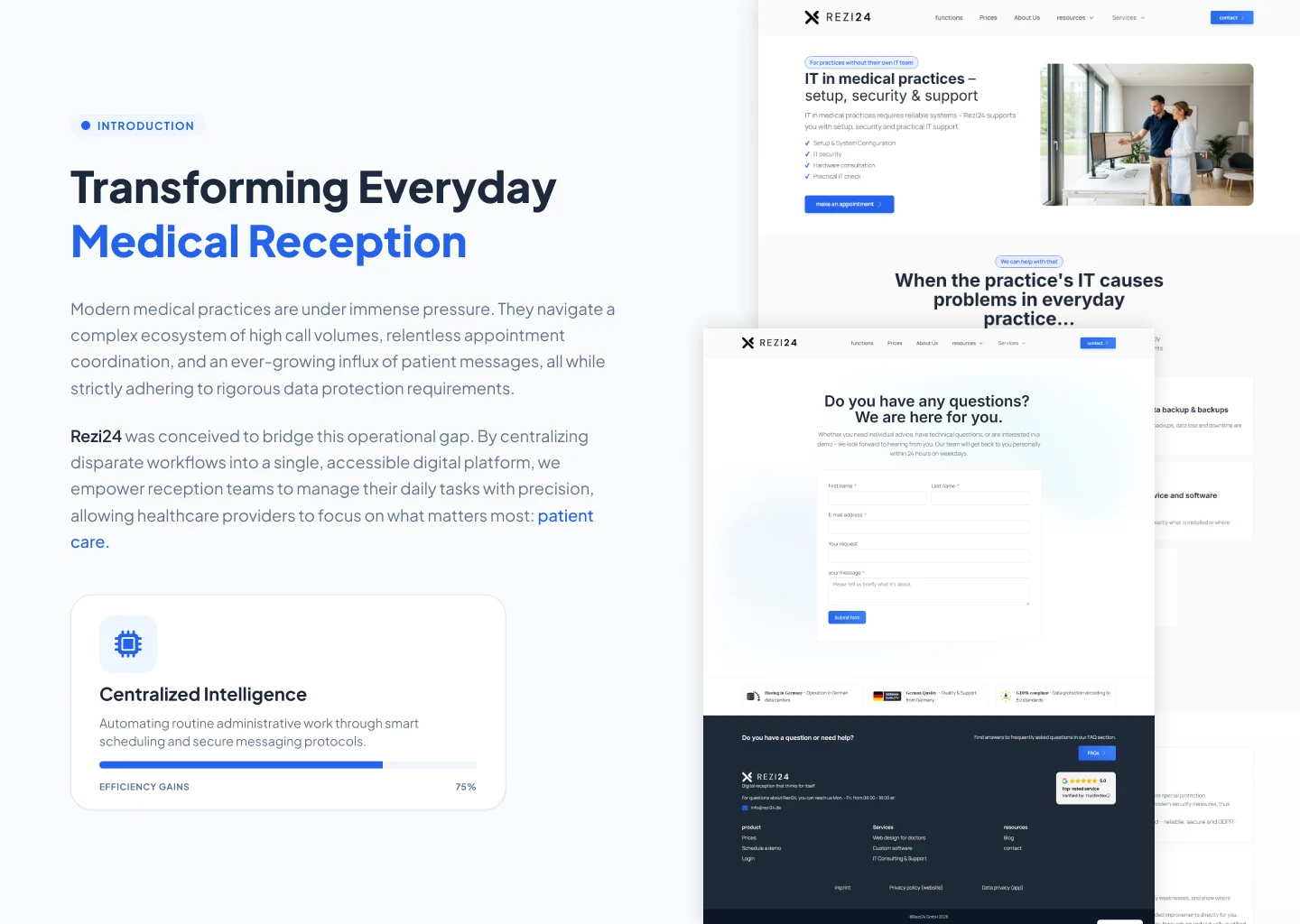
Every market has the proof points that make a cautious buyer say yes, and in German healthcare they're unusually specific. Rezi24 leads with exactly the ones that matter: operation in German data centres, German quality and support, and GDPR-compliant data protection to EU standards: stated plainly, on the page, where a practice owner deciding whether to trust their patient data to a platform can see them. The service also holds a 5.0 "Top-rated service" rating verified by Trustindex, third-party proof rather than a self-declared badge.
We've learned that trust signals only work when they're true and specific. "Secure" means nothing; "hosted in German data centres, GDPR-compliant, verified 5.0 on Trustindex" means something a buyer can check. This is the same principle behind how we present our own credibility: verifiable, specific, and backed by work you can look at.
What building for the German market taught us
Compliance-by-design is a different discipline from compliance-as-a-review. Designing to German data-protection standards from day one (hosting, data model, access, encryption) is not the same job as passing an audit at the end. The first produces a system you can defend; the second produces a system you have to patch. We'd argue this applies to every regulated build, but the German market makes the lesson impossible to skip.
"Made and hosted in Germany" is an engineering decision, not a slogan. Where data physically lives, which standard you design to, and how you prove it are architectural choices with real weight in this market. Treating them as marketing is how foreign vendors lose German healthcare clients.
Non-technical users are the hardest users to build for, and the most valuable. A reception team that can run the platform without IT support is worth more than any feature list. Every hour of setup you remove is an adoption barrier you remove, and for B2B products aimed at non-technical professionals, that ease is the product.
Serving a new market well earns the next client in it. Rezi24 was our first EU engagement, delivered end to end from concept and design to a launched, multi-tenant platform hosted in Germany and built to GDPR and EU data-protection standards. Doing it properly is what makes "we build healthcare software for the German and EU market" a claim we can back.
Thinking about building healthcare software for Germany or the EU?
If you're building patient-facing software for the German or European market, the order of operations matters more than the feature list: decide your data-protection posture first (where it's hosted, which standard it's designed to, how you'll prove it) and let that shape the architecture, not the other way around. That's the single thing we'd tell any founder entering this market, and it's what we did on Rezi24.
We build GDPR-compliant healthcare and SaaS platforms for clients across the US, UK, Australia, and now the EU, and we're happy to give you an honest read on your specific compliance environment before anyone quotes a number. If that's the conversation you need, tell us what you're building.
Rezi24 holds a 5.0 "Top-rated service" rating verified by Trustindex, built and launched at rezi24.de on German data centres to GDPR and EU data-protection standards. The engagement is currently on hold. Read the full case study →
Stay connected
Build notes, launches, and new articles from the Teamseven team.