
What a Compliance-Ready Healthcare Build Actually Requires (And Where an Agency's Job Ends)
The honest boundary between what a software agency builds and what a compliance firm certifies, and why that boundary matters for healthcare buyers.

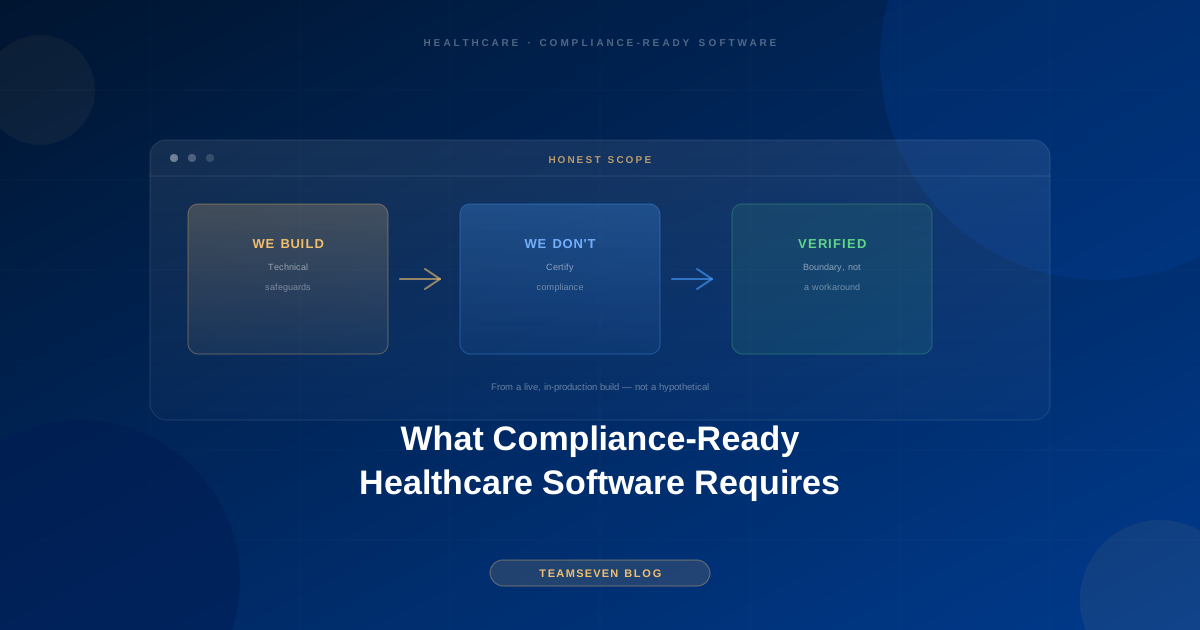
Search "HIPAA compliant software development agency" and you'll find no shortage of agencies claiming exactly that: certified, guaranteed, compliant out of the box. Almost none of it is accurate in the way the phrase implies, and it's worth being specific about why, because the gap between what's claimed and what's deliverable is where healthcare buyers get burned.
HIPAA compliance isn't a software feature
This is the part that gets lost in agency marketing copy: HIPAA compliance is a property of an organization's practices, policies, and controls, not a checkbox a piece of software can tick on its own. A covered entity (a hospital, a clinician, a health plan) is what has HIPAA obligations. Software is a tool that either supports meeting those obligations or undermines them.
That means no agency can hand you "HIPAA-compliant software" the way you'd buy a firewall appliance. What an agency can do is build software whose architecture makes your organization's compliance achievable, and what it can't do is certify that your organization, with its specific policies, staff training, physical safeguards, and business associate agreements, is compliant. That's a broader scope than code, and it's a different discipline.
What we build, and what that covers
On projects like COMPASS, our research platform for Ball State University, we build to HIPAA's Security Rule technical safeguards as architectural requirements:
- Access controls: role-based permissions, resource-level authorization, deny-by-default new features. See our engineering breakdown of this for the specifics.
- Audit controls: append-only logs of who accessed what data, when, and what they did with it.
- Encryption: in transit always, at rest as standard, and client-side where the data and access pattern justify it (as we did on Slotwise).
- Integrity controls: mechanisms to detect improper alteration or destruction of health information.
- Transmission security: encrypted channels for any data that moves between systems.
These are the technical safeguards a competent engineering team can and should build correctly, without needing to be a compliance firm to do it.
What we don't do, and why that's not a gap: it's a boundary
We don't issue HIPAA certifications. There is no single official "HIPAA certified" seal issued by HHS or any government body: any vendor claiming one is already overstating what exists. What exists is a compliance program, assessed and maintained by the covered entity, often with an outside auditor's help.
We don't execute Business Associate Agreements on your organization's behalf with your other vendors, or manage your organization's administrative safeguards: staff training, incident response procedures, physical access controls to your offices. Those are organizational responsibilities that sit with the covered entity, not the software vendor.
We don't replace a compliance audit. If your investors, board, or regulators require formal certification or a third-party compliance assessment, that's a parallel engagement with a specialist compliance firm: one whose entire job is exactly that assessment.
Why this honesty is the safer choice for buyers
An agency that tells you "don't worry, we'll make it HIPAA compliant" without qualification is either overpromising or doesn't understand the scope of what they're promising. Both are worse than a clear boundary, because the gap surfaces later, usually during due diligence, an actual incident, or your first serious enterprise sales conversation where a prospective customer's security team asks pointed questions your vendor can't answer.
The healthcare platforms that hold up under real scrutiny are the ones where the engineering team built defensible technical safeguards from day one, and where everyone involved, agency and client, was clear from the start about which parts of "compliant" the software addresses and which parts are organizational. COMPASS passed multiple IRB re-reviews without remediation specifically because the access-control architecture was sound from the outset, not patched in after a reviewer flagged a gap.
What to ask a healthcare software vendor
If you're evaluating agencies for a healthcare or clinical build, the questions that separate a competent technical partner from marketing copy:
- "What specific technical safeguards do you build in by default, and which are optional?"
- "Can you walk me through your access-control model for a project like mine?"
- "Do you claim to certify HIPAA compliance, or do you build to its technical requirements? Those are different things, which one are you offering?"
- "Have you worked with a compliance firm or auditor before? What did that handoff look like?"
An agency that answers these precisely, without hedging into vague reassurance, is a better bet than one that leads with "fully HIPAA compliant" in its first sentence.
Stay connected
Build notes, launches, and new articles from the Teamseven team.