
Staff and emergency vehicles wait behind visitors at the barrier.
Permitted plates go straight through.
ANPR recognises staff and emergency vehicles and opens the gate without a ticket or a stop.
Hotel and hospital parking
Our parking platform runs at a national ambulance service and major hotel chains in Australia. Staff and emergency vehicles get straight in, guests and visitors pay without queueing, and the gates keep working if the internet drops.
At a hotel a stuck gate annoys a guest. At an ambulance station it cannot happen at all.
These sites mix people with very different rights: staff on shifts, emergency vehicles, guests staying three nights, visitors staying an hour, and contractors. A single tariff and a ticket machine cannot tell them apart.
That is why the gate controller on each site holds its own copy of the access rules. If the site loses its internet connection, permitted vehicles still get in and out. The ambulance service deployment passed their operational reliability review on that basis.
The problems businesses in this industry bring to us most.
Staff and emergency vehicles wait behind visitors at the barrier.
ANPR recognises staff and emergency vehicles and opens the gate without a ticket or a stop.
Guests queue at reception to validate parking.
Guest plates are added to the booking, so they drive in and out without a ticket.
An internet outage would lock people in or out.
Each site’s controller keeps the current rules locally, so permitted vehicles keep moving.
You pay someone to manage the barrier at peak times.
Operators on our platform reallocated the staff time that used to go on peak-hour access.
Parking built around who is allowed where.
Plates read and matched to permits, bookings and tariffs.
~25,000 transactions a month.
Shift staff, emergency vehicles and contractors with their own rules.
Stays, day visits and validations, without paper tickets.
Local controllers that keep working if the connection drops.
Contactless payments through Windcave or Stripe at the barrier.
Numbers are as reported by the clients. We say plainly which ones we still work with.
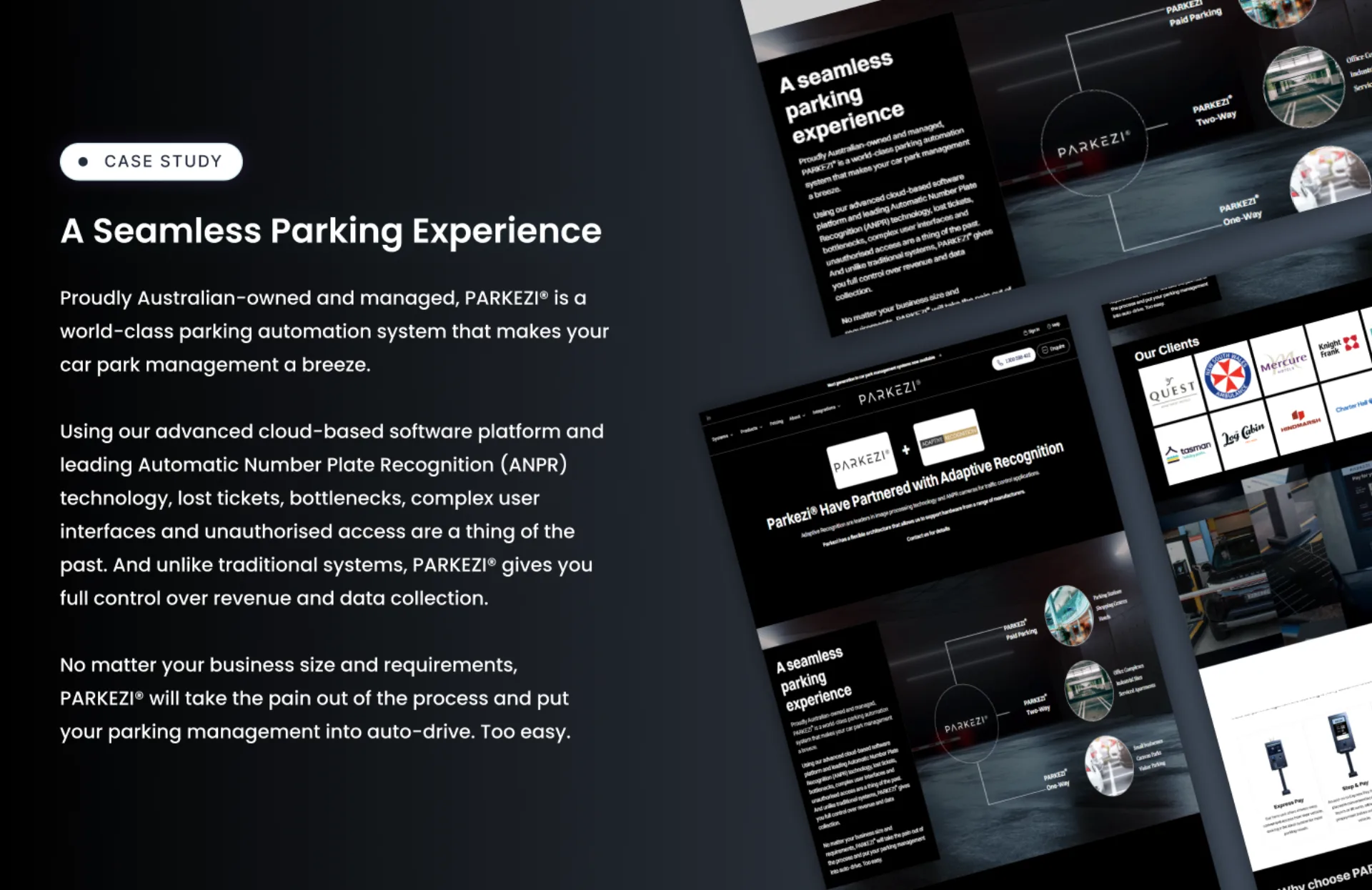
Car parks that run without staff: ANPR cameras read the plate, the gate opens, and the driver pays through Windcave or Stripe. We built the software and still maintain it.
The same steps on every project. You approve designs before we write code.
Bring the problem and how you handle it today. We ask questions and tell you honestly what we would build first. We won’t pitch at you.
What is in scope, what goes on the backlog, the stack we’d use and why, the timeline and one price.
A kick-off meeting, a shared Slack channel and access to the repository. Rehan is your day-to-day contact.
We design the main screens and journeys first. Nothing gets coded until you have signed the designs off.
We agree the architecture before writing code, then build with updates twice a week on Slack. Any new request is logged as extra hours and reported weekly.
Deployed to production with your Git repositories and documentation handed over. Bug fixes are free for the first two months.
Real ranges from our own projects. Your number comes from the scoping call, as a fixed quote.
After the free two months, maintenance is $700 a month. New features are quoted as you need them, or you can have a dedicated engineer from $2,500 a month.
Platform-level reviews of the agency — not cherry-picked project comments.
What I love about Team7 is that they always say: No worries, we can find a solution. This is the mindset of builders, creators, people who do not have fear, the partner you need if you want to excel.
Working with Mo and his team over the past year has been nothing short of exceptional. I was admittedly sceptical about investing such a large amount, but results exceeded every expectation.
Their responsiveness and willingness to take on our challenging task were impressive.
They are amazing and consistently exceed expectations. They go above and beyond what is asked of them and their communication is top notch, so much so that we joke that they never sleep. The best of the best.
Straight answers on experience, cost and how we work.
Ask us something elseThe gate controller on site keeps the current access rules, so staff, emergency vehicles and permit holders still get in and out. It catches up with the cloud platform when the connection returns.
Yes. A guest’s plate can be added to their stay, so they drive in and out and the parking is charged to the room or paid at the barrier.
No. We build the software and integrate with the hardware you choose, through its SDK or API.
Bug fixes are free for two months. After that, maintenance is $700 a month. New features are quoted as you need them, or you can have a dedicated engineer from $2,500 a month.
You do. At handover you get the Git repositories and written documentation. There is nothing tying the software back to us, so you can take it to an in-house team whenever you like.
Rehan, one of our two founders, is your day-to-day contact. You get updates on Slack twice a week and can see the code in your repository at any time. We split working hours between us to cover US, UK and Australian time zones, and we usually reply within an hour, sometimes the next morning.
A 30-minute call. Tell us who parks there and what hardware you have. We’ll tell you what the software involves.