
The Hidden Cost of Manual Processes, and How to Measure Yours
Manual work rarely shows up as a cost line. A simple method to measure what re-keying, chasing and hand-built reports cost your business, in one week.

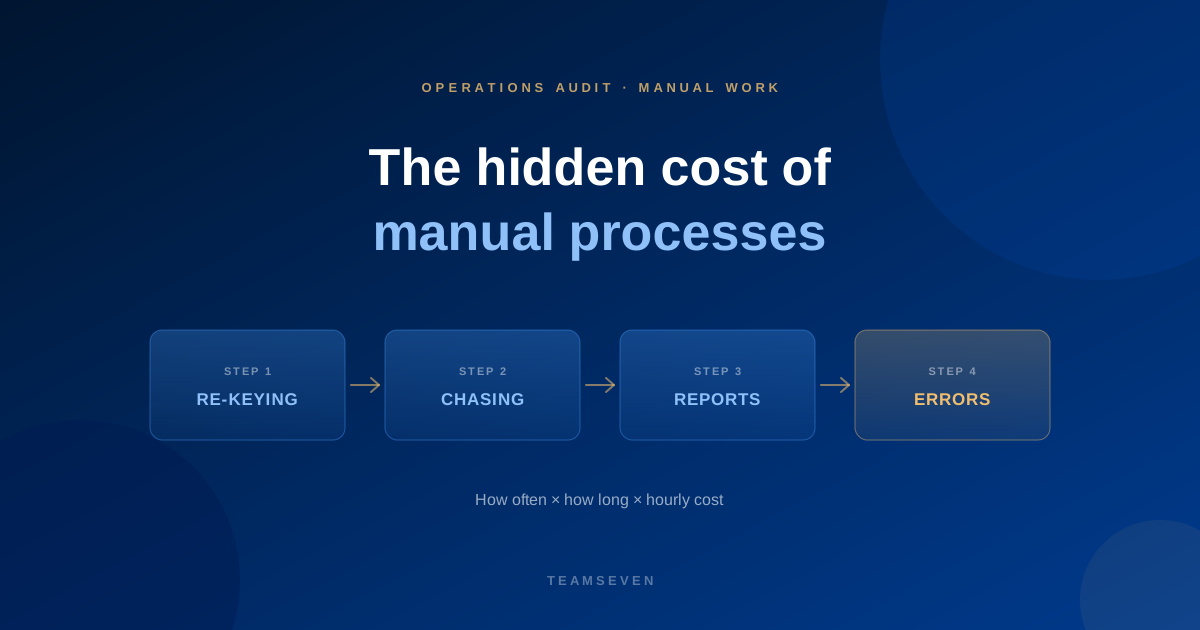
Nobody puts "copying data between systems" on a budget. It doesn't arrive as an invoice. It arrives as a team that is always busy, jobs that slip, and a vague sense that the business should be able to do more with the people it has.
That is why manual processes survive for so long. Their cost is real but spread thinly across many people and many days, so it never adds up to a number anyone has to approve.
This post shows how to make that number visible. You don't need industry averages. Your own numbers are more useful, and they are easier to get than you think.
What counts as a manual process
We mean any step where a person does something a system could do, or where a person carries information between systems. The common ones:
- Re-keying. Typing the same customer, job or order details into several tools.
- Chasing. Following up quotes, approvals, signatures and payments by hand.
- Searching. Hunting through inboxes, chats and folders for the latest version of something.
- Assembling reports. Copying numbers from several places into a spreadsheet every week.
- Reconciling. Matching payments to invoices, or jobs to timesheets, at month end.
- Remembering. Anything that happens because one person knows to do it.
None of these is wrong on its own. Some are the right call at a small size. They become a problem when volume grows and the same manual step now happens many times a day.
The four costs of manual work
1. Time
The obvious one, and still usually underestimated, because each instance is short. Twenty minutes here, ten there. It hides in the gaps between "real" work.
2. Errors
Every re-key is a chance for a typo. A wrong postcode sends a crew to the wrong place. A wrong price becomes a disputed invoice. The cost of an error is rarely the time to fix it. It is the refund, the lost customer or the job that has to be redone.
3. Delay
Manual steps wait for someone to be free. A quote sits until the estimator is back. An invoice goes out at the end of the week instead of the end of the job. Delay costs you in cash flow and in customers who accept a faster competitor's quote.
4. Fragility
When a process depends on one person's memory or one person's spreadsheet, the business is exposed every time they are ill, on holiday or leave. This cost is invisible until the day it isn't.
How to measure it in a week
Pick one process, for example from enquiry to invoice. Then:
Step 1: List the manual steps. Walk through a real, recent example with the person who does it. Write down every step where they copy, chase, search, assemble or remember.
Step 2: Count how often each happens. Per job, per day or per week. Use your records where you can: number of jobs, quotes, invoices.
Step 3: Time each one. Ask, or better, watch. People underestimate small tasks.
Step 4: Put a cost on the time. Use each person's rough hourly cost, including employment costs, not just salary.
Step 5: Add the errors. Ask the team about the last few mistakes caused by this process and what fixing them cost.
Step 6: Note the delays. How long does work wait at each manual step? What does that do to cash or customers?
A worked example
These numbers are made up to show the method. Use your own.
A firm handles 40 jobs a week. For each job, an administrator copies the customer and job details from the enquiry email into the CRM, the scheduling tool and later the invoice: three re-keys at about 5 minutes each. That is 15 minutes a job, or 10 hours a week, just on typing.
Add a weekly report that a manager builds by hand in 2 hours, and month-end reconciliation that takes a day. Then add the two or three jobs a month that go wrong because an address or price was mistyped.
Put hourly costs against those hours, multiply by the working weeks in a year, and add the cost of the mistakes. The total is usually large enough to change the conversation from "we should tidy this up one day" to "this is costing us more than fixing it would".
Where to look first
In our experience the biggest manual costs cluster in the same places:
- Between the quote and the job. Details agreed with the customer that don't make it to the people doing the work.
- Between the job and the invoice. Extras, changes and timings that have to be pieced together.
- Between the invoice and the accounts. Invoices retyped into the accounting package, and payments matched by hand.
That third one is common enough that we build accounting sync into operational systems as standard. i-mve sends invoices to Xero, QuickBooks or Sage so nobody at any of its 523 companies has to retype them. Read more on accounting integration.
What to do with the number
Once you have a cost per process, you can make a sensible decision:
- Small cost, simple fix. Switch on an automation in a tool you already have, or change who does what.
- Medium cost, tools don't talk. Connect them. An integration often removes a whole category of re-keying.
- Large cost, work is specific to you. That is when custom software earns its place.
Before committing money, compare the yearly cost of the manual process with the cost of fixing it. Our guide to calculating the ROI of automation shows how.
Is manual work always bad?
No. At low volume, or for a step that changes often, doing it by hand can be the right choice. Automating a process that isn't settled yet just locks in today's mistakes. Measure first, and automate the steps that are frequent, repetitive and stable.
How do I convince my team to track time on small tasks?
Don't ask them to log every minute. Ask them to talk you through one real example of the process, and time it together. People are usually glad someone is finally looking at the parts of their day they find most frustrating.
Can Teamseven measure this for us?
Yes. Our business process audit starts with a free 30-minute call where you walk us through a normal week. The written proposal shows what we found, what it costs you and what to fix first. The full method is in how to audit a B2B business for time and money leaks.
Stay connected
Build notes, launches, and new articles from the Teamseven team.