Your ERP, CRM, accounting, and industry platforms hold the same data and none of them talk to each other. We connect them so data moves automatically and reliably: point-to-point integrations, a central integration layer where you need one, APIs for the systems that lack them, and the monitoring that keeps it all working when a vendor changes something.
A clean integration layer is also what an AI agent needs to act through: well-defined, scoped endpoints give the agent a safe, observable way to read and write across your systems. Several clients build this first so an agent has real tools to call.
Fixed-price, scoped after we have assessed each system. Get your number →
If one of these is a daily cost, here is what we do about it.
The same order gets keyed into three systems, and one of them is always wrong.
One entry, synced everywhere. An integration that pushes the record between systems automatically, with reconciliation so the three views always agree.
You have a Zapier tangle that breaks weekly and nobody fully understands it.
We replace it with something maintainable. Proper code or a managed integration layer, version-controlled, monitored, and documented, so a change is a ticket, not a mystery.
A vendor changed their API and your integration failed silently for two days.
Validation and alerting built in. A changed payload is caught at the boundary, retries handle transient failures, and your team is alerted within minutes.
The system you most need to connect has no API worth the name.
We find the route in. Database replica, scheduled export, or an API we build in front of it. We assess each system first and price the hard ones honestly.
We recommend the smallest architecture that fits how many systems you have and how often they change.
Direct connections between two systems: a CRM to your accounting package, an ops platform to a carrier, a web form to your database. Right for a small number of stable connections. Built with retries, validation, and monitoring, not a fragile script.
One place to manage routing, transformation, and monitoring for many connections. When you have several systems or they change often, a hub stops one change from breaking three integrations. We build it on maintainable, version-controlled infrastructure you own.
When the system you need to integrate has no usable API, we build one in front of it: a clean interface over the database or internal logic, so everything else connects to a stable contract rather than reaching into the internals.
The unglamorous core of integration: mapping fields, resolving format differences, handling the records that do not match cleanly, and defining the rules for what wins when two systems disagree. Documented so it is not tribal knowledge.
Near-real-time integration where it matters: webhook receivers with signature validation, event queues that absorb spikes, and dead-letter handling so a message that cannot be processed is captured, not lost.
Dashboards showing every connection's health, alerting when one fails, and a compatibility layer for vendors known to ship breaking changes, so their changes are absorbed in one place instead of cascading through your systems.
They overrun when the difficulty of a source system is a surprise. We assess every system before we scope.
For every system in scope: does it have a documented API, what does it expose, what are the rate limits, how fresh does the data need to be, and what breaks if the sync fails? We tell you which connections are straightforward and which need a workaround, before the price is fixed.
Based on the number of systems, how often they change, and how critical the flows are, we recommend the architecture that fits and explain the tradeoffs. We do not sell a hub when three point-to-point connections would do.
Field mapping, format handling, and the reconciliation rules for where systems disagree, documented and signed off before build. This is where integrations succeed or fail.
Schema validation, retries with backoff, dead-letter handling, and alerting are part of every connection, not added after the first outage. We build assuming the source systems will misbehave, because they will.
Where an integration replaces a manual process, we run both for a period and compare, so your team trusts the automated flow before the manual one stops.
Each integration documented: what it connects, what it maps, how it handles failure, and how to change it. Infrastructure handed over. A 30-day support window is standard, retainers available for connections to volatile vendors.
Fixed-price, scoped after we have assessed each system, because the difficulty lives in the source systems.
Two or three systems with usable APIs connected directly, with validation, retries, and monitoring. 6–12 weeks.
A central integration layer connecting many systems, including ones without good APIs. Delivered in phases, highest-value connections first. 12–24 weeks.
A hub plus an ongoing retainer to add connections, adapt to vendor changes, and keep the whole set healthy as your stack evolves.
If the goal is one system consolidating everything else, see Custom Software. If it is a reporting view across systems, see Data Engineering.
30 minutes. List the systems. We will tell you which connections are easy and which are not.
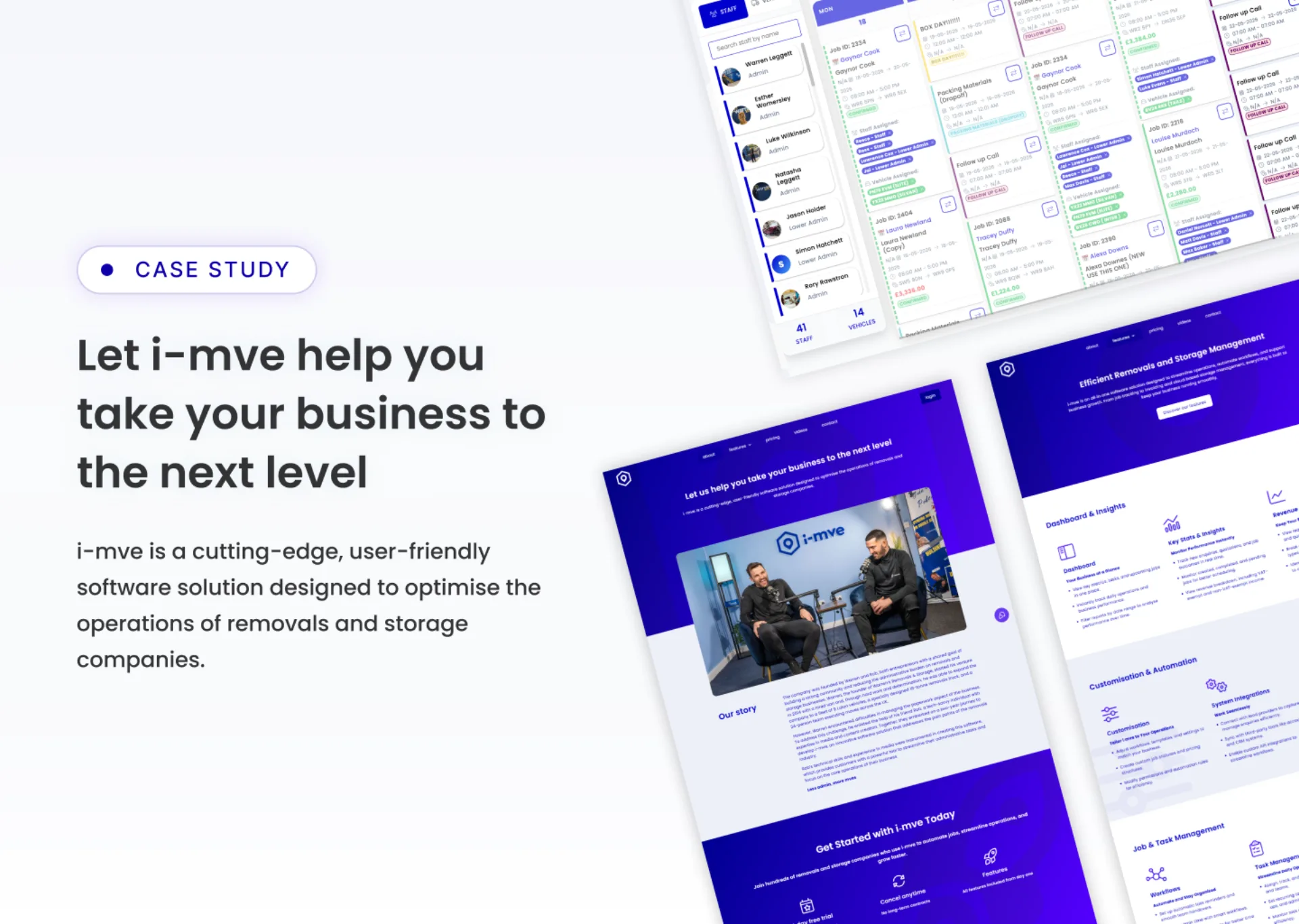
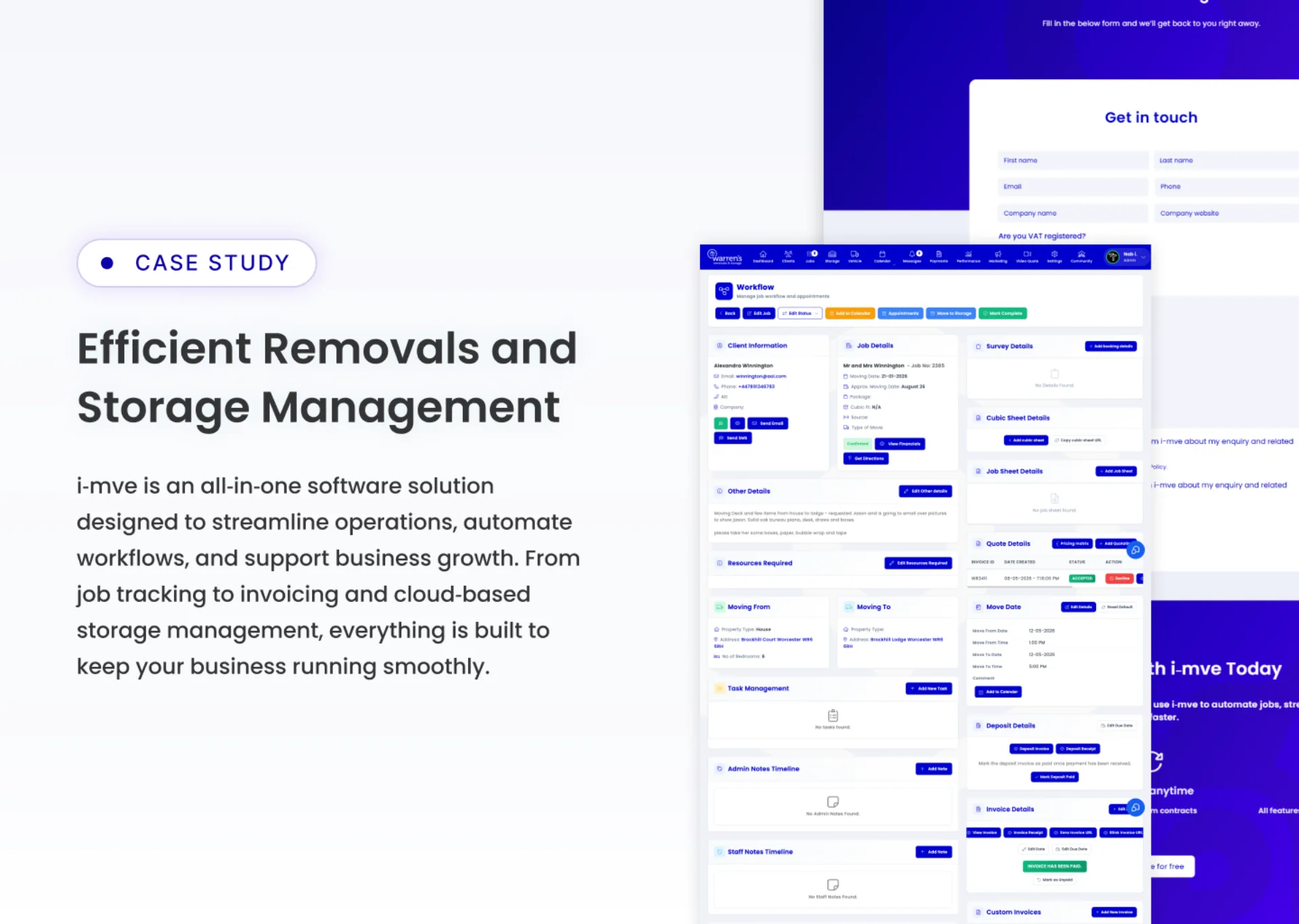
i-mve keeps job, quoting, invoicing, and accounting data in sync across Xero, QuickBooks, and Sage for 510 UK companies, with the quoting and invoicing engine running without anyone touching it. Across live client platforms we have connected Stripe, PayPal, Salesforce, HubSpot, Twilio, SendGrid, and industry-specific systems in logistics, healthcare, and property since 2017. Every integration we build is documented and yours to own, with zero vendor lock-in.
Straight answers on approach, systems without APIs, vendor changes, cost, and ownership.
Systems integration is connecting your separate software systems so data moves between them automatically and reliably, instead of by manual re-entry, CSV export, or a person copying figures between screens. It covers point-to-point integrations, a central integration layer or middleware, API development where a system lacks one, and the error handling, retries, and monitoring that keep the connections working when a source system changes or goes down.
API development is often building one API for one system. Systems integration is the wider job of making several systems work together: choosing between point-to-point connections and a central hub, handling the systems that have no usable API, dealing with each vendor's rate limits and quirks, and keeping the whole set of connections observable. API development is usually a component of a systems integration project.
Often, yes. Options include a direct database connection or replica, scheduled file exports and imports, screen-level automation where nothing else exists, or building a proper API in front of the system first. Which approach fits depends on what the system allows and how real-time the integration needs to be. We assess each system during scoping and tell you honestly which connections are straightforward and which need a workaround.
Point-to-point is fine for two or three connections that rarely change. Once you have several systems, or the connections change often, point-to-point becomes a tangle where one change breaks three things. A central integration layer, sometimes called an integration hub or middleware, gives you one place to manage transformations, routing, and monitoring. During scoping we look at how many systems, how often they change, and how critical the data flow is, then recommend the approach that fits.
We build for that. Integrations include schema validation so a changed payload is caught rather than silently corrupting data, retry logic with backoff for transient failures, dead-letter handling for messages that cannot be processed, and alerting so your team knows within minutes, not when a customer complains. Where a vendor is known for breaking changes, we add a compatibility layer so their changes are absorbed in one place.
Across live client platforms we have connected Xero, QuickBooks, Sage, Stripe, PayPal, Salesforce, HubSpot, Twilio, SendGrid, and a range of industry-specific platforms in logistics, healthcare, and property. i-mve keeps job, invoicing, and accounting data in sync across Xero, QuickBooks, and Sage for 510 companies. The integration discipline is the same regardless of the specific systems.
A focused project connecting two or three systems with clear APIs typically takes 6 to 12 weeks. A central integration layer connecting many systems, some without good APIs, runs 12 to 24 weeks and is delivered in phases so the highest-value connections land first. Timeline depends almost entirely on how cooperative the source systems are, which is why we assess them before committing to a schedule.
Fixed-price, scoped after we have assessed each system. The cost is driven by how many systems, how good their APIs are, how much data transformation is needed, and how real-time the sync has to be. We do not quote an integration project without understanding what we are connecting, because the difficulty lives in the source systems.
You do, completely. Integration code, transformation logic, configuration, and infrastructure transfer to you. We build on standard tools and document each connection, so your team or another vendor can maintain and extend the integrations without us.
Yes. Most of our clients are in the United States, United Kingdom, and Australia, with agreed real-time overlap hours for each region. For UK and EU integrations we consider where data flows and how personal data is handled between systems under GDPR.
Yes, and we design it with that in mind. A clean integration layer with well-defined, scoped endpoints is exactly what an AI agent needs to act through: it gives the agent a safe, observable way to read and write across your systems. Several clients build the integration layer first specifically so an agent has real tools to call.
Platform-level reviews of the agency — not cherry-picked project comments.
What I love about Team7 is that they always say: No worries, we can find a solution. This is the mindset of builders, creators, people who do not have fear — the partner you need if you want to excel.
Working with Mo and his team over the past year has been nothing short of exceptional. I was admittedly sceptical about investing such a large amount — but results exceeded every expectation.
Team 7 is the best group of developers on Fiverr — and I promise it is not even close. The software they have developed has changed our company for the better.
30 minutes. No slides. We will assess what each system allows and tell you honestly what connecting them takes, and what it will cost.