Custom CRM vs Salesforce vs HubSpot: An Honest Comparison (From Someone Who Builds Custom)
When Salesforce or HubSpot is the right call, when a custom CRM wins, and how to tell which side you're on, from an agency that builds custom.

I build custom CRMs for a living, so you'd expect me to tell you to build one. I'm not going to do that, because for most businesses it would be bad advice.
Salesforce and HubSpot are excellent products. Most companies should use one of them. This article is about the specific minority who shouldn't, and how to tell whether you're in it.
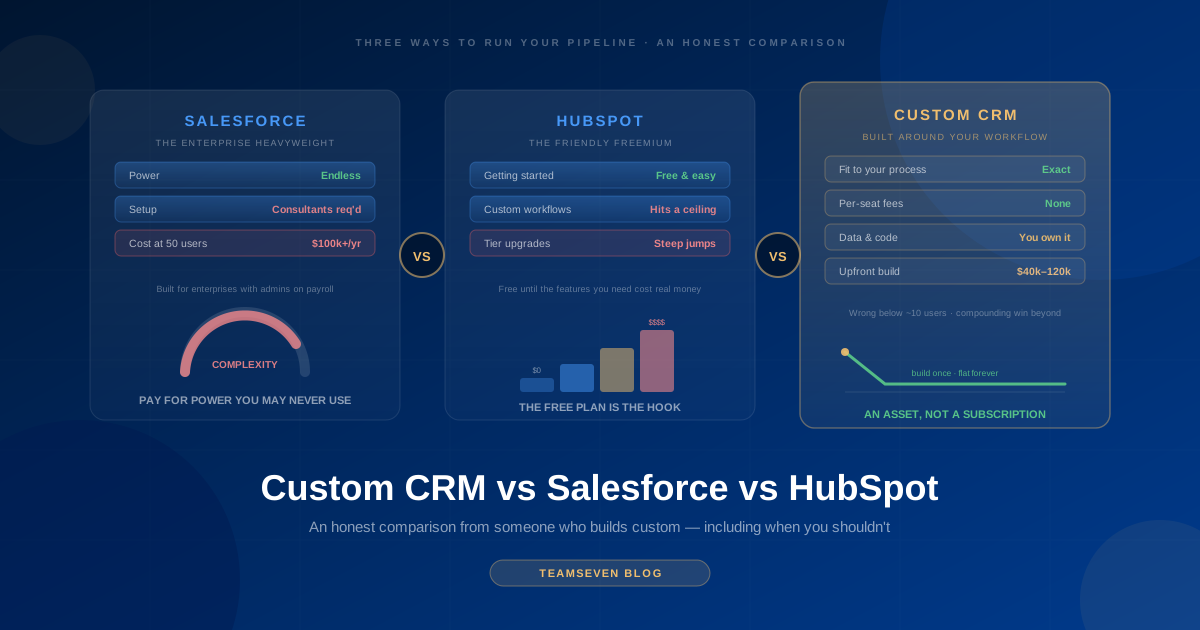
The short version
| Salesforce | HubSpot | Custom CRM | |
|---|---|---|---|
| Best for | Large orgs, complex sales, big ecosystems | SMBs, sales+marketing in one, ease of use | Specialised operations that don't fit either |
| Time to running | Weeks–months (implementation) | Days–weeks | 3–9 months (build) |
| Upfront cost | Low (subscription) + implementation | Low (subscription) | High (build cost) |
| Ongoing cost | Per seat, forever, rises with headcount | Per seat, forever | Hosting + maintenance, flat |
| Fit to your workflow | Configurable, never exact | Configurable, never exact | Exact. It's built for you |
| You own it | No | No | Yes: code, data, IP |
| Needs an admin | Usually yes | Not really | No, but needs a maintenance partner |
When Salesforce is right
Salesforce wins when you're a large organisation with a complex sales operation, when you need the enormous ecosystem of apps and integrations, when you have (or will hire) admin expertise in-house, and when your requirements are complex but still fundamentally sales requirements.
It's a powerful platform and its depth is real. If you have the scale to justify it and the expertise to run it, it's a serious tool.
Where it goes wrong: small and mid-sized businesses buying Salesforce because it's the name they know, then discovering they need a consultant to configure it, an admin to maintain it, and they still only use 20% of it. That's an expensive way to store contacts.
When HubSpot is right
HubSpot wins for small and mid-sized businesses that want sales and marketing in one place, that value ease of use over infinite configurability, and whose process looks like a sales pipeline.
It's well-made, quick to adopt, and people use it, which is more than can be said for a lot of CRM deployments. For most SMBs with a normal sales motion, HubSpot is the sensible default and I'd recommend it without hesitation.
If your business is "we get leads, we qualify them, we close them, we keep in touch": use HubSpot. Stop reading. You do not need a custom CRM.
When custom wins
Custom is the right call in a narrower set of circumstances than most agencies will admit:
Your core workflow isn't a sales pipeline. This is the big one. If the heart of your business is quoting with complex logic, scheduling crews and vehicles, managing jobs, tracking inventory or storage, or some operational process that a CRM has no concept of, then a CRM is being asked to do something it wasn't built for, and it will do it badly.
This is exactly what we found building i-mve for UK removals companies. Their business isn't a sales funnel. It's enquiry → survey → complex quote → job → crew and vehicle scheduling → storage → invoice → accounting. A general CRM handles the first two steps and has no idea what to do with the rest. So those companies ran a CRM and spreadsheets and a scheduling board, re-keying between them. The CRM wasn't wrong; it was just never designed for their business.
Your pricing or business logic is complex. If quotes are calculated from many variables with real rules, that logic needs to live in software. Stuffing it into custom fields and hoping is not a solution.
Per-seat costs have become punishing. At 25, 50, 100 seats, subscription costs compound into serious money, and you're renting forever. At that scale, owning your system starts to make financial sense (see the cost comparison in our CRM cost guide).
You need integrations the platforms don't have. i-mve needed Compare My Move, PinLocal, Getamover for leads, and Xero/QuickBooks/Sage for accounting. Some of that just isn't native anywhere, and paying for middleware to bridge a system that doesn't fit is throwing good money after bad.
The workarounds have become the job. If your team spends hours a week copying data between the CRM and the spreadsheets that hold the real work: that friction has a cost, it recurs forever, and it's usually bigger than any licence fee.
The honest test
Ask yourself one question: does your business work the way the CRM assumes it does?
If yes (pipeline, leads, deals, contacts) buy HubSpot or Salesforce. They'll serve you well, they're cheaper, they're faster, and they're maintained by someone else.
If no (if the real work happens in the part the CRM doesn't understand, and you've built a scaffolding of spreadsheets around it to compensate) then the CRM isn't fitting, and no amount of configuration will make it fit. That's when custom is worth the money.
What people get wrong in both directions
Building custom to save subscription money. Bad reason. If the platform fits, the subscription is excellent value. Custom only pays back when the fit is wrong.
Buying a platform because it's the safe choice, then working around it forever. Also bad. The workaround labour is a real, compounding cost that never appears on an invoice, so it's easy to ignore, and it's often the biggest cost of all.
Assuming "custom" means "start from scratch on everything." It doesn't have to. Sometimes the answer is a custom operational system that integrates with a platform CRM you keep for the sales bit. Hybrid is a real option and often the smart one.
What I'd tell you honestly
Most businesses reading this should use HubSpot. A smaller number, with genuine scale and complexity, should use Salesforce. A minority, the specialised operations whose real work lives outside the pipeline, should build custom, and for them it's transformative rather than merely nice.
I've built the custom ones. I've also told people to go use HubSpot, and I'd tell you the same if that's what fits. The clients worth having are the ones you were honest with.
FAQ
Should I buy Salesforce, HubSpot, or build a custom CRM? Ask one question: does your business work the way the CRM assumes it does? If your work really is pipeline, leads, deals and contacts, buy HubSpot or Salesforce. They're cheaper, faster, and maintained by someone else. If the real work happens in the part the CRM doesn't understand, and you've built a scaffolding of spreadsheets around it to compensate, no amount of configuration will fix the fit. That's when custom earns its cost.
When is Salesforce the right choice? When you need a mature, heavily configurable platform with a large ecosystem of integrations and consultants, and your process fits a recognisable sales motion. It's powerful and well-supported. The trade-off is licence cost per seat and the configuration overhead that comes with that power.
When is HubSpot the right choice? When you want something that works quickly out of the box for sales and marketing without a configuration project. It's the pragmatic default for teams whose process is fairly standard and who value speed over exact fit.
Is a custom CRM cheaper than Salesforce or HubSpot over time? It can be, but not in year one. Subscriptions scale with every seat and never stop; a custom build is a larger fixed cost you own outright. The crossover depends entirely on your headcount and how long you keep the system, so run the three-year maths on your real user count rather than the sticker prices.
Can I keep my existing CRM and build custom around it? Often, yes, and it's frequently the better answer. A custom layer on top of an existing CRM (a portal, an automation service, an integration bridge) solves the specific misfit without replacing everything, and it's a far smaller project than a full custom build.
Stay connected
Build notes, launches, and new articles from the Teamseven team.