7 Signs You've Outgrown Your CRM (And What To Do About It)
The warning signs your CRM no longer fits (spreadsheet workarounds, manual re-keying, and workflows the software doesn't understand) and what to do next.

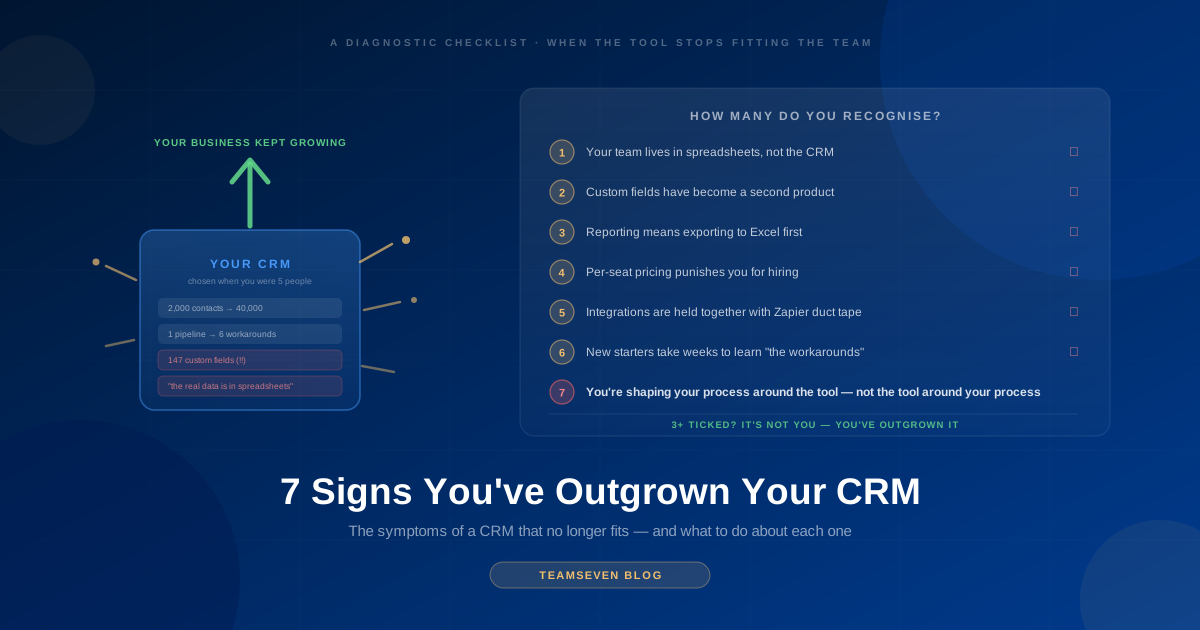
Nobody wakes up and decides their CRM has stopped working. It happens slowly. Someone builds a spreadsheet to handle the bit the CRM can't do. Someone else starts a second spreadsheet. A year later, the CRM is a contact database and the real work happens somewhere else entirely.
Here are the signs that's happening to you, and what to do about it.
1. The spreadsheets have taken over
The clearest signal. If the real work (the quoting, the scheduling, the job tracking, the thing that makes you money) lives in spreadsheets while the CRM holds names and phone numbers, your CRM has been quietly demoted to an address book.
Every removals company we spoke to before building i-mve had this exact pattern. CRM for contacts. Spreadsheet for quotes. Whiteboard or another tool for scheduling. Accounting software at the end. Four systems, none connected.
2. Your team re-types the same data into multiple systems
Count the number of times a single customer's details get entered by a human across your whole process. If it's more than once, you're paying people to be an integration layer. That cost is real, it's recurring, and it never shows up on an invoice, which is exactly why it goes unnoticed for years.
3. The most important part of your job doesn't exist in the CRM
Ask yourself what the core operational thing your business does is. Quoting? Scheduling? Job management? Storage? Now ask whether the CRM has any real concept of it.
If the answer is no (if the CRM understands "deals" but not "jobs," "contacts" but not "crews") then the software was built for a different kind of business than yours. No amount of custom fields fixes a mismatch that fundamental.
4. Your pricing logic lives in someone's head (or in a fragile spreadsheet)
If quotes are calculated with real rules (volume, distance, resources, materials, dates) and that calculation happens in a spreadsheet that one person maintains and nobody else fully understands, that's a business risk as much as a software problem. That logic should live in software where it's consistent, auditable, and doesn't leave when that person does.
5. Per-seat costs are climbing faster than the value
As you hire, the CRM bill grows. That's fine if everyone's getting full value. It's not fine if you're paying a per-seat price for a system most of your staff use as a glorified contact list while doing their actual work elsewhere.
Do the arithmetic on what you'll pay over the next five years at your projected headcount. Then ask whether you're getting that much value. Sometimes you are. Sometimes the number is startling.
6. Nobody uses it properly
The most damning sign of all. If adoption is poor (if people avoid it, work around it, or maintain their own shadow systems) that's rarely because your team is lazy. It's usually because the software is asking them to work in a way that doesn't match how the job gets done.
Software that fits gets used. Software that fights gets abandoned.
7. You've been quoted for "customisation" more than once
If your answer to every CRM gap has been another consultant, another add-on, another middleware tool, another configuration project: add up what you've spent on making a general system approximately fit. Then compare it to what a system built for you would have cost. People are often surprised.
So what do you do?
First, be honest about which problem you have. There are two very different diagnoses here, and they have opposite treatments:
Diagnosis A: you're using the wrong platform, or using it badly. Maybe you're on Salesforce when HubSpot would fit better, or nobody ever configured it properly, or the team was never trained. This is common and it's much cheaper to fix than building custom software. Try this first. A better-fitting platform or a proper implementation solves a lot of CRM misery.
Diagnosis B: no platform fits, because your operation is specialised. Your core workflow isn't a sales pipeline. Your business logic is complex. The workarounds exist because the software fundamentally doesn't understand your business. This is when custom becomes the right answer, and it's a smaller group than most agencies would like you to believe.
The test: could any off-the-shelf CRM, properly configured, handle your core operational workflow? If yes, your problem is fixable without building anything. If no (if the thing your business does has no home in any CRM on the market) that's when a custom system stops being a luxury and becomes the sensible answer.
That's precisely why i-mve exists. Not because removals companies wanted bespoke software, but because their actual work (surveys, complex quotes, crews, vehicles, storage) had nowhere to live in a general CRM. So it lived in spreadsheets, and the spreadsheets were costing them hours every week.
Start by counting the workarounds. They're the clearest evidence you have.
Stay connected
Build notes, launches, and new articles from the Teamseven team.