
Why CRM Implementations Fail (And How to Not Be One of Them)
Most CRM projects fail on adoption, not technology. The real reasons (poor fit, bad data migration, no ownership) and how to avoid each one.

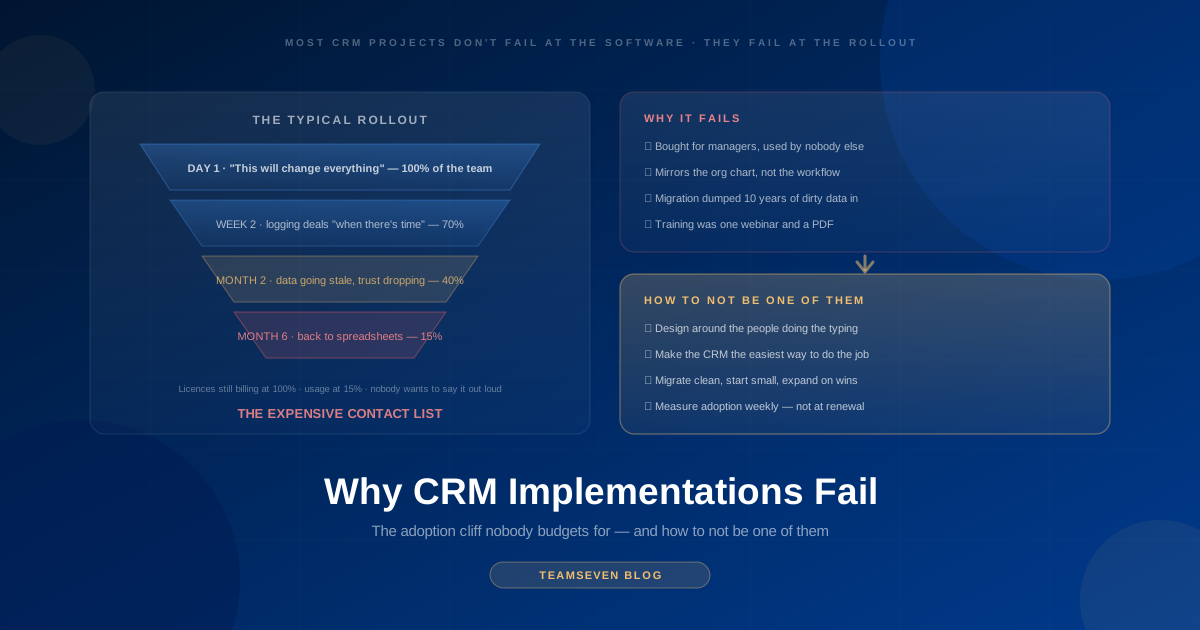
CRM projects fail at a alarming rate, and almost never for the reason people assume. The software usually works fine. The project fails anyway.
Having built CRMs and watched plenty of implementations go sideways, here's what kills them.
Failure 1: Nobody validated that the workflow fits
The most common and most fatal. Someone chooses a CRM based on features, demos, and reviews, without ever mapping the company's actual day-to-day workflow against what the software assumes.
Then it's deployed, and the mismatch appears where it always appears: at the operational level, with the people who have to use it. The salesperson can log a lead but there's nowhere to put the survey. The ops manager can see a deal but not a crew schedule. Everyone quietly reverts to spreadsheets, and within a year the CRM is a very expensive contact list.
How to avoid it: map your real workflow first (enquiry to cash, every step) then test whether the system handles each step. Not "can it be configured to": does it handle it, in a way your team would use. If a step has no home, you've found your problem before you've paid for it.
Failure 2: Data migration was an afterthought
Your existing data is messy. Everyone's is. Duplicates, half-filled fields, inconsistent formats, notes in the wrong places, records nobody's touched in five years.
If you migrate that mess straight into a new system, you now have a new system full of the same mess, and users lose trust in it immediately. Once people don't trust the data, they stop using the system, and the project is effectively dead.
How to avoid it: treat migration as its own project with its own budget. Clean the data before it moves. Decide explicitly what not to bring across. And validate it after: a sample check that the records landed correctly. This is unglamorous work and it's the difference between adoption and abandonment.
Failure 3: No one owns it
A CRM without an owner drifts. Nobody maintains the data quality, nobody enforces the process, nobody fixes the small annoyances, and it slowly rots until it's useless.
How to avoid it: one named person owns the system. Not a committee. Someone whose job includes keeping it healthy, and who has the authority to say how it's used.
Failure 4: The team was never brought along
The CRM was chosen by management and dropped on the team. Nobody asked the people who'd use it every day what they need. So the software solves the problems management could see and ignores the ones the team lives with.
The result is predictable: the team resents it, uses it minimally, and keeps doing the real work in their own systems.
How to avoid it: involve actual users early: in choosing it, in configuring it, in testing it. The people doing the job know things the org chart doesn't. This isn't a soft nicety, it's the single biggest predictor of adoption. We built i-mve with heavy input from people who run removals operations, and it's the main reason it's used rather than worked around.
Failure 5: It made someone's job harder
If the CRM adds work (more data entry, more clicks, more admin) without visibly giving something back, people won't use it. They'll do the minimum and keep their own records. And they'll be right to, because you've made their day worse.
How to avoid it: for every user role, be able to answer plainly: what does this give them? If the honest answer is "it gives management visibility and gives you extra typing," you have an adoption problem waiting to happen. Good CRM removes work: automatic quotes, no re-keying into accounting, no chasing paperwork. That's why people use it.
Failure 6: Over-customisation turned it into a monster
The opposite failure. Rather than accepting a slight mismatch, the company customises endlessly (custom objects, custom fields, custom automations, layers of consultant work) until the system is a fragile bespoke creation built on a platform never meant to bend that far. It's expensive, brittle, upgrade-hostile, and only one consultant understands it.
How to avoid it: notice when you've crossed the line. If the configuration effort is approaching the cost of building something that fits, you've been building custom software all along, just badly, and on someone else's platform. At that point, an honest conversation about a purpose-built system is overdue.
Failure 7: Integrations were assumed, not verified
"It integrates with our accounting system" turns out to mean a partial sync that doesn't handle the fields you need, or requires a paid middleware tool, or breaks every time the other system updates.
How to avoid it: verify every critical integration before you commit. Not "is there an integration": does it do the specific thing you need, reliably? Ask for a demo with your actual use case. Integrations are usually where the value is, and where the disappointment is.
The pattern underneath all of these
Every one of these failures is the same failure wearing a different hat: the software and the business were never aligned, and nobody checked before it was too late.
The technology is almost never the problem. Salesforce works. HubSpot works. Custom CRMs work. What fails is deploying software into a business whose actual workflow it doesn't fit, then hoping training and enthusiasm will close the gap. They won't.
So do the boring thing first: map how your business works in detail, including the bits people work around. Then choose, or build, accordingly. That single step prevents most CRM failures before they start.
FAQ
Why do CRM implementations fail? Because the workflow fit was never validated. The recurring failures are structural rather than technical: nobody checked the CRM matches how the business works, data migration was an afterthought, no one owned the system after launch, the team was never brought along, and integrations were assumed rather than verified.
What's the most common CRM mistake? Making someone's job harder. If the CRM adds admin work for the people expected to use it without giving them something back, adoption quietly fails no matter how good the software is. Usage, not installation, is the measure of success.
Should I customise my CRM heavily? Carefully. Over-customisation is one of the classic failure modes. It turns a maintainable product into a fragile monster that's expensive to upgrade and impossible to hand over. If you need that much customisation, that's a signal the platform may not fit your business.
Why does data migration cause so many CRM problems? Because it's treated as a final step rather than a project. Extracting, cleaning and correctly loading existing data is real work, and doing it badly means the new system launches full of data people don't trust, which is fatal for adoption.
Who should own a CRM after it goes live? A named person inside the business, with the authority and time to keep it working. Systems without a clear owner drift: nobody fixes the data, nobody adjusts the process, and it degrades until people route around it.
Stay connected
Build notes, launches, and new articles from the Teamseven team.