How We Built a CRM for the UK Removals Industry (And Why Generic CRMs Failed Them)
The real story of building i-mve: a custom CRM used by 523 UK removals firms. Why Salesforce and HubSpot didn't fit, and what we built instead.

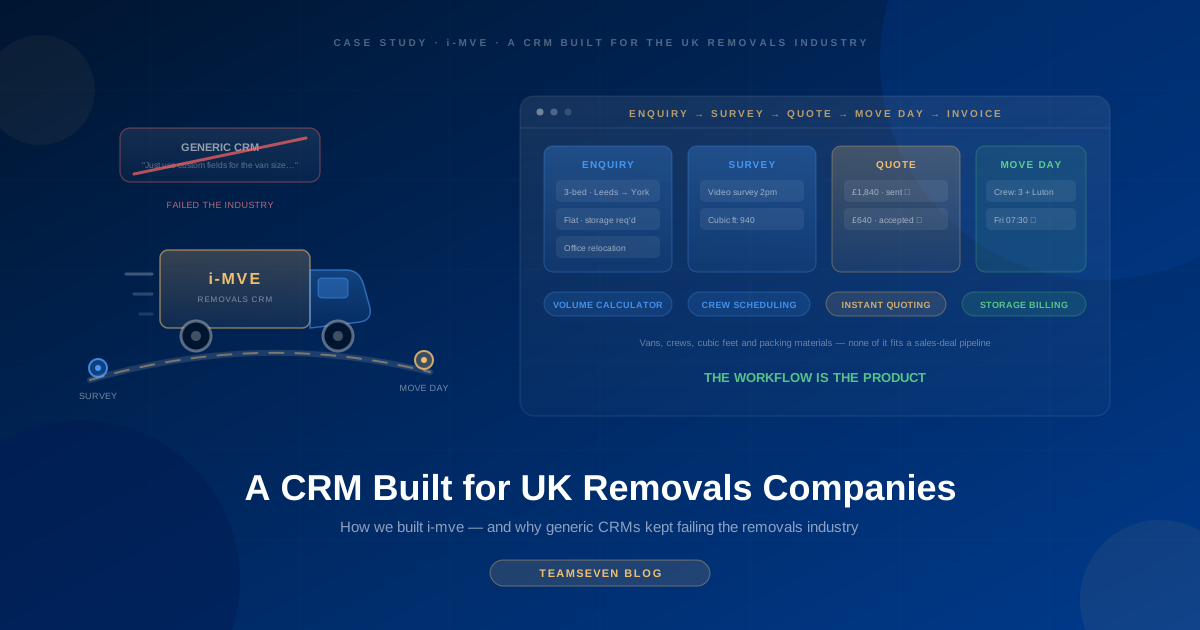
Most CRM articles are written by people who sell CRM subscriptions. This one is written by someone who built one from scratch for an industry that generic CRMs had comprehensively failed.
That CRM is i-mve. It's now used by 523 UK removals and storage companies to run their operations: quoting, jobs, crews, invoicing, the lot. I want to walk through why it had to exist, what made it hard, and what it taught me about when a custom CRM is the right call.
The problem: a removals company is not a sales pipeline
Here's what a generic CRM assumes about your business. You have leads. Leads become opportunities. Opportunities move through stages. Someone closes them. Then, largely, the CRM's job is done.
Now here's what happens at a removals company.
An enquiry comes in: maybe from the website, maybe from a lead platform like Compare My Move, maybe a phone call. Someone has to survey the job, either in person or via video, to work out volume, access, stairs, parking restrictions, whether a piano is involved. That survey produces a quote, and the quote has to account for crew size, van size, distance, date, packing materials, storage if needed, insurance. If the customer accepts, it becomes a job, which means allocating a crew and a vehicle on a specific date, generating paperwork, tracking materials, managing storage units if the goods are going into store, and eventually invoicing, chasing payment, and pushing it all into the accounting system.
Try mapping that to "lead → opportunity → closed won." It doesn't fit. The quote isn't a number you type in, it's a calculation with a dozen inputs. The "close" isn't the end, it's the beginning of the operational work. And the operational work is where removals companies live.
This is why the removals firms we spoke to were doing what almost every SME in a specialised trade does: running the CRM for the sales bit, a spreadsheet for the quoting bit, a whiteboard or a different tool for the scheduling bit, and re-typing everything into accounting software at the end. Four systems, none of them talking, all of them requiring the same data entered again. Hours a week lost to admin that software should have handled.
Why they couldn't just use Salesforce
I want to be fair to the big CRMs here, because they're good products. Salesforce and HubSpot are excellent at what they're built for.
But they're built to be configured, not to fit. You can customise Salesforce enormously: add fields, build objects, write automations. What you end up with is a general-purpose system bent into an approximate shape, where every person using it has to remember which custom field means what, and where the workflow the software wants and the workflow the business has are permanently slightly out of alignment.
For a large enterprise with a Salesforce admin on staff, that's a fine trade. For a removals company with 20 staff and no IT department, it's a nightmare. The configuration cost is high, the ongoing maintenance requires expertise they don't have, and the per-seat licensing keeps climbing.
The specific things that broke: the quoting logic was too complex to live in a CRM field. The job scheduling wasn't a CRM concept at all. The integrations they needed (Compare My Move, PinLocal, Getamover for leads; Xero, QuickBooks, Sage for accounting) weren't native, and building them into a general CRM meant paying for middleware and maintaining it forever.
So they didn't use it properly. They used a fraction of it and worked around the rest. Which is the most common outcome of forcing a general CRM onto a specialised operation: you pay for a lot of software and use a little of it, badly.
What we built
i-mve isn't a CRM with a removals skin. The domain is baked into the data model.
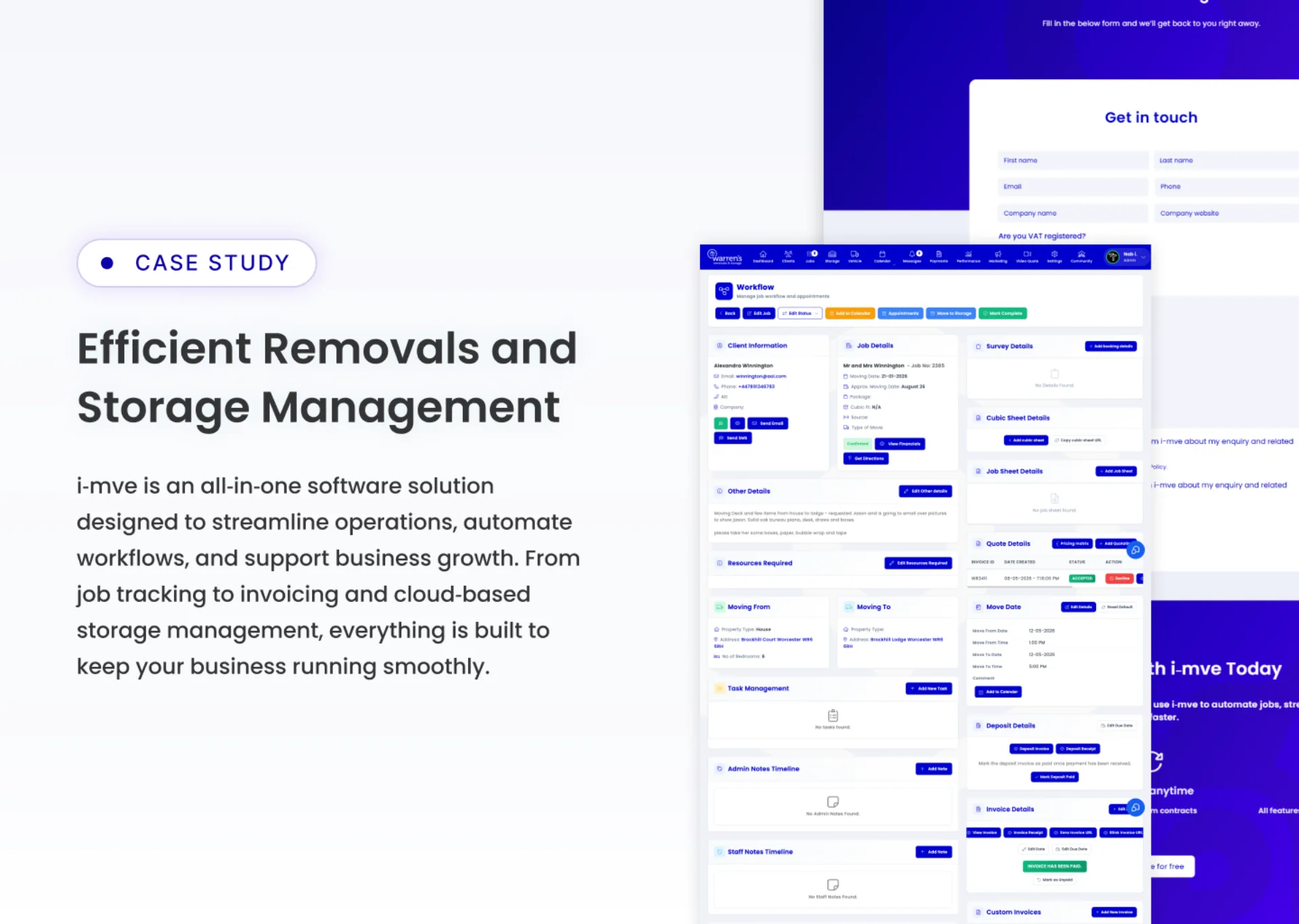
Enquiries and surveys. Enquiries land from multiple sources (website, phone, and the lead platforms) and they arrive as removals enquiries, with the fields a removals job needs, not as generic "leads." Surveys attach to them properly.
A real quoting engine. This was the hard part and the most valuable. The quote is calculated from the actual variables (volume, distance, crew, vehicle, packing, storage, insurance, date) with the company's own pricing rules applied. Not a number someone types into a field. The pricing logic lives in the software, which means quotes are consistent, fast, and don't depend on which staff member happened to build them.
Jobs, crews, and vehicles. When a quote is accepted it becomes a job, and a job has a date, a crew, a vehicle, and paperwork. The scheduling isn't bolted on. It's a first-class part of the system, because for a removals company it is the business.
Storage. Removals companies often store goods. That means units, containers, ongoing storage billing, and knowing whose stuff is in which container. Generic CRMs have no concept of any of this.
Invoicing and accounting integration. Invoices generate from the job, and they sync to Xero, QuickBooks, or Sage: whichever the company uses. This one integration alone removed hours of re-keying per week, and it's the thing customers mention most.
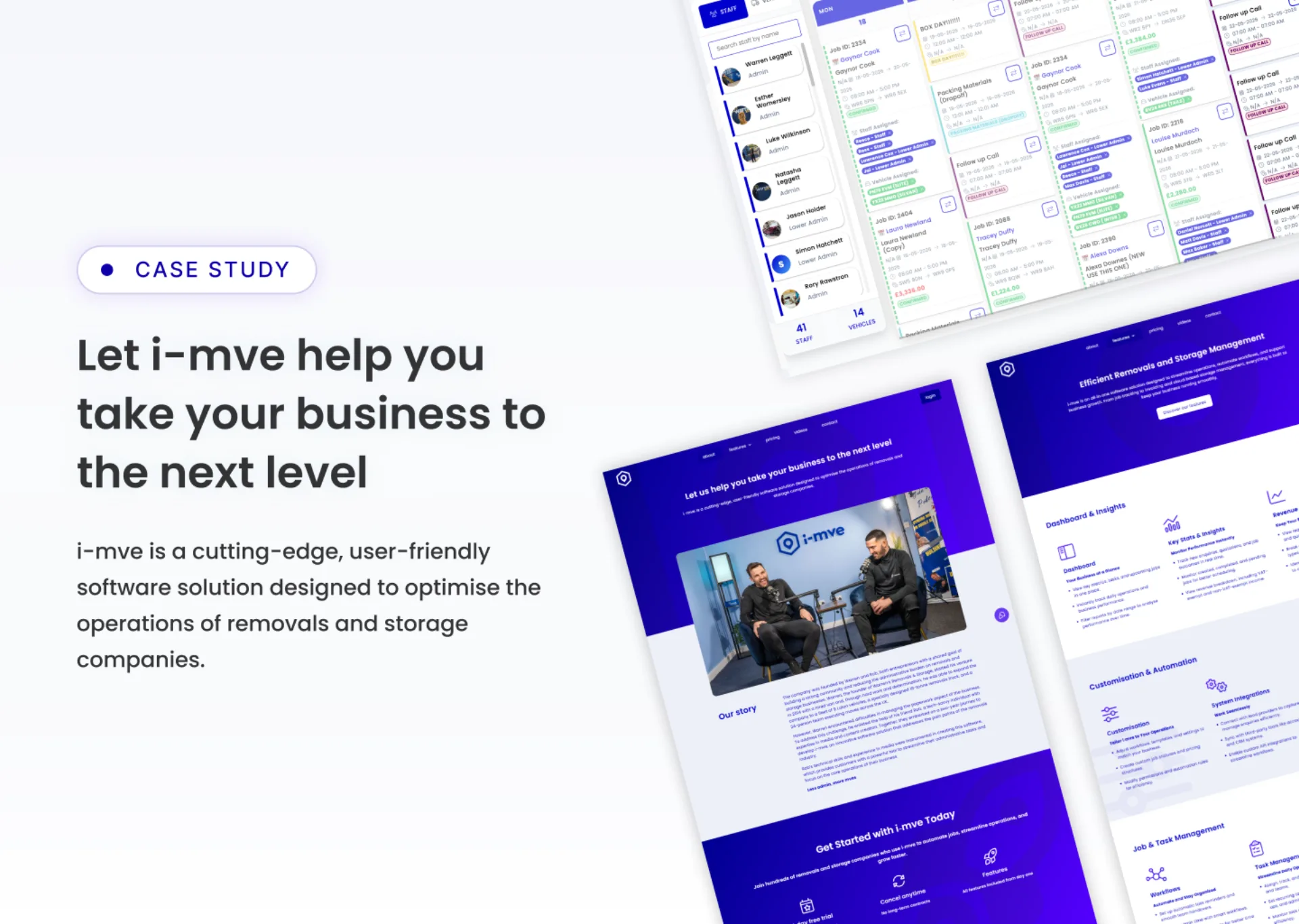
Lead platform integrations. Compare My Move, PinLocal, Getamover, the platforms UK removals firms buy leads from, feed straight into the system. No copying enquiries by hand from an email into a spreadsheet.
Every one of those is unremarkable on its own. The point is that they're all in one system, sharing one data model, so the enquiry that arrives becomes the survey that becomes the quote that becomes the job that becomes the invoice, without anyone retyping anything.
What building it taught me about custom CRM
The value isn't features, it's the absence of friction. Nothing in i-mve is technically novel. What makes it worth paying for is that the work flows through it without stopping. Every place where a person had to copy data from one system to another was a place we deleted. That's the entire product thesis, and it's the honest answer to "why not just use Salesforce", because with Salesforce, those copy-paste gaps stay.
Vertical beats horizontal when the domain is complicated enough. A general CRM has to serve everyone, so it serves no one precisely. A CRM that knows what a survey is, what a crew is, what a storage container is, can be simple and complete. That's only possible because it gave up on being general. The specificity is the feature.
The integrations are half the product. People think of a CRM as the screens. For an operational business, the CRM is only as good as what it connects to. Accounting and lead sources were where most of the value landed, and where most of the engineering time went.
You have to understand the business before you write code. We spent real time understanding how removals companies operate (the surveys, the access problems, the way pricing works) before building anything. There is no shortcut here. A team that doesn't understand the domain builds a beautiful system that doesn't fit, and that's worse than useless.
Should you build a custom CRM?
Honest answer, and I'll argue against myself because I'd rather you make the right call.
Don't build one if a general CRM fits how you work. If you have a sales pipeline and your business really is "leads become customers," HubSpot or Pipedrive will serve you well for a fraction of the cost of custom software. Building custom to avoid a subscription is almost always a bad trade.
Build one if you recognise the pattern above: a CRM for one part, spreadsheets for another, re-keying between systems, and a core workflow (quoting, scheduling, an operational process) that the CRM has no concept of. If your business is specialised enough that the general tools force painful workarounds, that friction is a real, ongoing cost, and custom software is how you delete it.
The test I use: is the way you work different from the average business, in ways that matter? Removals companies are. That's why i-mve exists, and why it's still running across the UK years later.
i-mve is live across 523 UK removals companies and has handled 352,506 jobs and 168,061 quotations worth £38.3 million. Read the full case study →
Related reading
Stay connected
Build notes, launches, and new articles from the Teamseven team.