How Much Does a Custom CRM Cost in 2026? An Honest Breakdown
A real cost breakdown for building a custom CRM: by complexity, by region, and by what drives the price. Plus the honest maths on custom vs Salesforce.

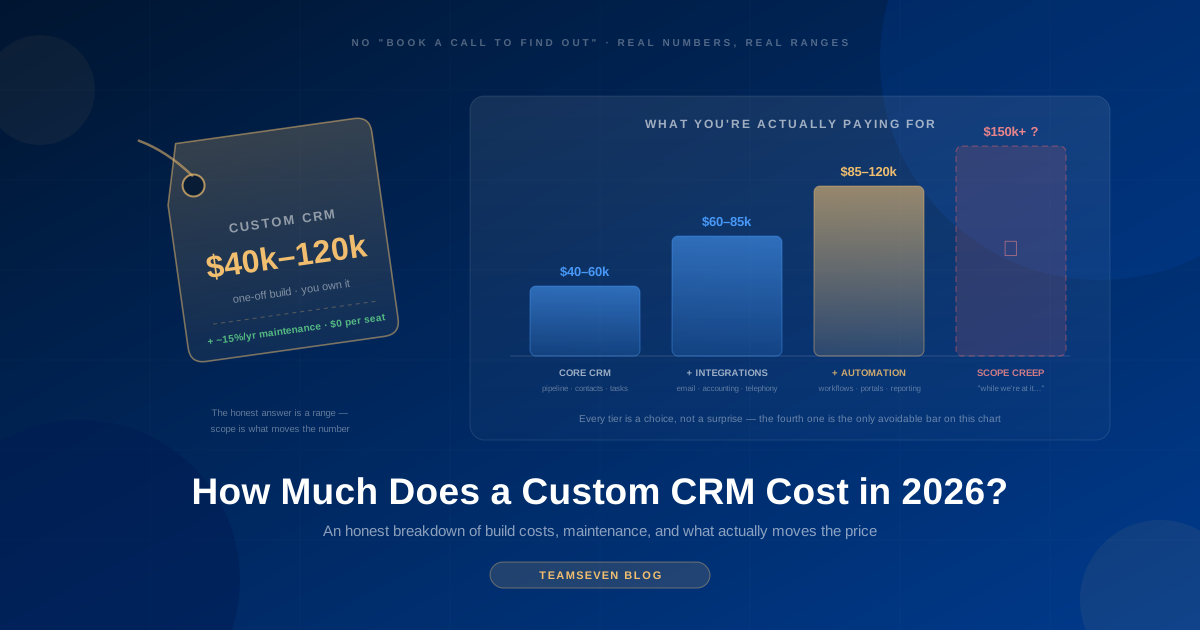
The honest answer to "how much does a custom CRM cost" has two parts, and most articles only give you the first one.
Part one is the build cost. Part two is the comparison, because a custom CRM isn't competing against zero, it's competing against paying a per-seat subscription every month for the rest of your company's life. Ignore that second part and you'll make the decision badly in either direction.
We built i-mve, a custom CRM now used by 523 UK removals companies, so these numbers come from having done it rather than from a pricing page.
The build cost
| CRM scope | South Asian agency | Eastern European | US/UK agency | Timeline |
|---|---|---|---|---|
| Focused CRM (contacts, pipeline, one core workflow, 1–2 integrations) | Scoped after a call | Scoped after a call | Scoped after a call | 12–20 weeks |
| Operational CRM (quoting, scheduling, jobs, invoicing, 3–5 integrations) | Scoped after a call | Scoped after a call | Scoped after a call | 20–36 weeks |
| Full platform (multi-role, complex logic, many integrations, portals) | Scoped after a call | Scoped after a call | Scoped after a call | 36+ weeks |
Professional agencies, full delivery: design, build, QA, deployment. Excludes hosting and maintenance. A US or UK agency's price for the same scope runs well above a South Asian or Eastern European team's, because so much of the rate is location, office costs and Western salaries, not the underlying engineering.
i-mve is closer to the full-platform tier once you count everything: a real quoting engine, job and crew scheduling, storage management, invoicing, document generation, plus multiple accounting and lead-platform integrations. That's a full operations platform, not a contact list: we've broken down its scope in more detail in our logistics software cost guide.
Where the money goes, line by line (focused CRM)
| Line item | Share of budget | Why it exists |
|---|---|---|
| Discovery & process mapping | Smaller, upfront | We map your actual process, including the parts that live in Saima's head and a spreadsheet called FINAL-v7 |
| UX design & prototype | Moderate | Clickable prototype your team reacts to before code exists |
| Data model & architecture | Moderate | The decisions that determine whether year-three features take days or rewrites |
| Core workflow engineering | The largest line item | Pipeline, records, views, permissions: the product itself |
| Admin panel | Smaller | User management, configuration, the controls you'll use weekly |
| Integrations (1 included, e.g. Xero) | Smaller, scales with each addition | Each additional integration adds cost proportional to how well-documented its API is |
| QA & test automation | Moderate | Regression suite so future changes don't break old features |
| Deployment, CI/CD, monitoring, handover | Smaller | Staging + production, error tracking, documentation, your keys to everything |
What's deliberately not in the build price: hosting (a modest recurring cost at this scale), data migration from your old system (scales with how messy the source data is), and post-launch iteration (budget 15–20% of build cost for the first quarter: the reasoning is in our hidden-costs breakdown).
What drives the cost
Integrations, usually the biggest factor. A CRM's value is largely in what it connects to. Accounting (Xero, QuickBooks, Sage), lead sources, email, calendars, payment, whatever industry platforms you depend on. Each integration is a mini-project, and the cost varies enormously with how good the third party's API is. A modern, well-documented REST API integrates in days. A legacy system with poor documentation can eat weeks. This is the number one thing to scope carefully before anyone quotes you.
Business logic complexity. This is the hidden one. A CRM that stores contacts is simple. A CRM that calculates something (a quote, a price, a schedule, a commission) is a different animal. The more your business rules live in the software, the more engineering there is. Most people underestimate how complicated their own pricing rules are until they try to write them down precisely.
Number of user roles. Sales sees one thing, operations another, finance another, management another. Each distinct role is its own interface and its own permissions. Multi-role done properly is real scope.
Data migration. You have data in your current system. Getting it out, cleaning it, and getting it in, correctly, is a real project on its own, and it's routinely forgotten in estimates. Ask about it explicitly.
Mobile. Do field staff need it on a phone? That's an additional platform.
The part everyone skips: the honest comparison
Here's the maths that decides this.
A mid-tier Salesforce or HubSpot seat is billed per user, per month, and that cost compounds in ways people don't picture upfront: multiply it by your headcount, then by every month you'll run it, then add the implementation consultant, admin time, add-ons, and middleware most companies end up needing for integrations the base tier doesn't cover. Run that out over five years and the total is rarely what the sticker price on the pricing page suggested.
Against that, a custom operational CRM is a build cost plus ongoing maintenance (budget roughly 15–20% of the build cost annually, covered below) plus hosting. Once it's built, there's no per-seat cost and no price rises to plan around.
For a large enough team run over a long enough horizon, custom comes out ahead, and the gap widens as headcount grows, because subscriptions scale with people and custom software doesn't.
But: and this is the honest caveat: that maths flips completely for a small team. At low headcount, the subscription is cheap and custom never pays back. The break-even is driven almost entirely by seat count and how long you'll run it. Run the numbers for your headcount before you decide anything, we can help you do that on a call.
Where the maths misleads people
Don't build custom just to escape a subscription. If the general CRM fits how you work, pay the subscription. It's a great deal. The subscription is only expensive when you're paying for a system that doesn't fit and still having to work around it.
The real cost of a bad fit isn't the licence. It's the friction. The removals companies using spreadsheets alongside their CRM weren't losing money on the licence. They were losing hours a week to re-keying data between systems. That labour cost, year after year, is usually larger than the software cost either way. When you're comparing, compare the total cost including the workaround labour, not just the invoice.
Maintenance is not optional. Budget 15–20% of build cost annually. Custom software needs updating: dependencies, security, and especially the third-party APIs it integrates with, which change whether you like it or not. An agency that doesn't mention maintenance is quoting you an incomplete number.
How to get your real number
Write down the workflows the CRM must handle, not features, workflows. What happens from enquiry to payment?
List the integrations by name. Accounting system, lead sources, email, anything industry-specific. This is your biggest cost driver.
Describe your business logic honestly. If quotes or prices are calculated, write out how. In detail. You'll be surprised.
Count your users and your roles. Both matter: one for the subscription comparison, the other for the build scope.
Then do the discovery phase properly. In a domain-heavy build like a CRM, this is where the accurate estimate comes from. A number quoted without discovery is a guess.
FAQ
How much does a custom CRM cost to build? It depends on scope. A focused CRM (contacts, pipeline, one core workflow, one or two integrations) is a smaller build running 12–20 weeks. An operational CRM with quoting, scheduling and invoicing is a bigger undertaking, typically 20–36 weeks. A US or UK agency charges considerably more than a South Asian or Eastern European team for the same stack, because so much of that rate is location rather than engineering. Book a call and we'll give you a real number for your scope.
Why is a custom CRM more expensive than a Salesforce or HubSpot subscription in year one? Because you're paying the build cost upfront instead of renting. The comparison flips over time: subscription costs scale with every seat you add and never stop, while a custom build is a fixed cost you own. The crossover depends on your headcount: run the three-year maths on your actual user count before deciding.
What drives custom CRM cost the most? Integrations, usually. Each one is a mini-project, and the effort depends entirely on the third party's API quality: a modern documented REST API integrates in days, a legacy system can eat weeks. After that: business logic complexity (a CRM that calculates quotes or commissions is a different animal from one that stores contacts), the number of distinct user roles, and data migration.
Is data migration included in a CRM quote? Often not, and it's routinely forgotten. Getting data out of your current system, cleaning it, and loading it correctly is a real project on its own. Ask about it explicitly before you sign anything. It's one of the most common sources of budget surprise.
How do I get an accurate custom CRM quote? List your integrations by name, write out your business logic in detail (especially anything that calculates a price or a schedule), and count both your users and your distinct roles. Then do a proper discovery phase. In a domain-heavy build like a CRM, that's where the accurate number comes from: a figure quoted without discovery is a guess.
Stay connected
Build notes, launches, and new articles from the Teamseven team.