Offshore Software Development for New York Startups and Businesses: A Practical Guide
A practical guide for New York founders and businesses evaluating offshore software development: costs, time zones, what works, and what to watch out for.

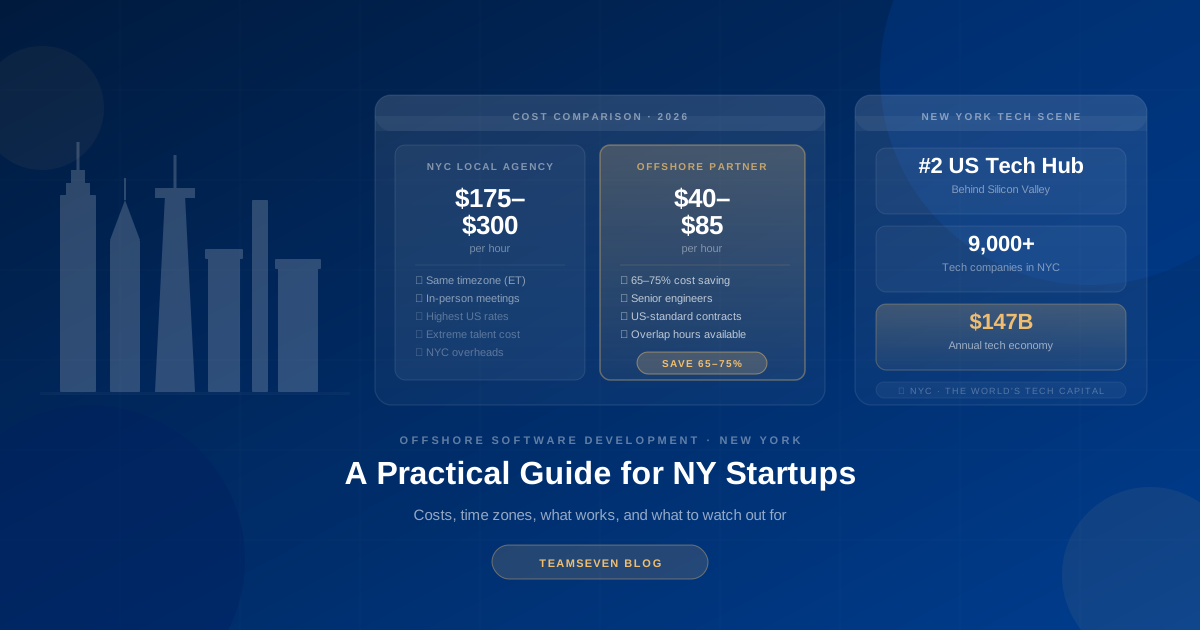
New York is one of the most expensive cities in the world to hire software developers. A senior full-stack developer in Manhattan commands a substantial salary on its own. Add employer taxes, benefits, and overhead, and the fully-loaded cost of a single senior engineer climbs well beyond that. For a startup that needs three engineers to build its first product, that's a serious annual commitment before a single line of production code is written.
This is why offshore software development has become a serious option for New York businesses, not a compromise, but a deliberate strategic choice by founders and CTOs who understand what quality engineering costs in the US market.
This guide is for New York founders, product managers, and business owners evaluating offshore software development for the first time. What it involves, what it costs, what the time zone reality looks like from New York, and how to find agencies that can deliver.
The New York software development market in 2026
New York has one of the strongest technology ecosystems in the United States. Fintech, media, enterprise SaaS, healthcare technology, and logistics software are all industries where New York companies are leading globally. The demand for software engineering talent in New York consistently outpaces supply.
The result is a seller's market for developers. A six-month custom software project with a team of three from a mid-size New York agency runs well into six figures. Even mid-market agencies charge rates that make sophisticated custom software inaccessible for early-stage companies.
This creates two categories of New York business that benefit most from offshore development:
Early-stage startups that need to build a product but can't afford New York agency rates or the full-time hiring cost of a local engineering team. Many of New York's most successful startups built their initial products offshore, not because they couldn't afford local talent eventually, but because offshore made the early stage economically viable.
Growth-stage companies that have proven their product and need to scale engineering capacity quickly. Hiring senior engineers in New York takes 3–4 months on average. An offshore agency can deploy a dedicated development team in 2–4 weeks.
What offshore software development looks like from New York
The most common concern from New York businesses evaluating offshore development is time zones. It's a legitimate concern, but it's also more manageable than it sounds.
Pakistan, where our agency is based, is 9–10 hours ahead of New York (EST/EDT). That means there's no direct overlap during standard business hours on either side. This is a real limitation for real-time collaboration.
What compensates for it:
Async communication done well. The best offshore agencies don't rely on real-time communication for day-to-day development. Sprint planning happens synchronously (a weekly or biweekly video call). Daily standups happen asynchronously: the team posts updates at the end of their day, which lands in your inbox before your workday starts. You wake up to progress reports, questions answered, and completed work ready for review.
Deliberate overlap windows. For urgent communication, a 7am EST call is a 4pm PKT call: workable for both sides. We schedule critical calls at the boundary between our working days for New York clients specifically.
Front-loaded clarity. The time zone gap is most painful when requirements are unclear and developers need to ask questions constantly. The solution is investing in clear sprint briefs, detailed user stories, and thorough design review before development starts. This is a discipline that offshore development imposes that most in-house teams don't have, and it generally produces better results.
Over-communication as a standard. Loom videos for walkthroughs, detailed Slack updates, well-maintained project boards. If you can see what's happening without asking, the time zone stops being a blocker.
Most New York clients we work with say that after the first sprint, the time zone becomes background noise. The first sprint is the hardest. That's where you establish the communication rhythm that the rest of the project runs on.
What it costs
Offshore rates from Pakistan for professional agencies sit well below New York rates across every role: senior full-stack and mobile developers, QA engineers, and UI/UX designers all carry a significantly lower rate than their New York equivalents, without a difference in seniority or process.
For a typical New York startup project (a SaaS MVP requiring a backend developer, frontend developer, and QA engineer) a six-month engagement for a team of three offshore comes in at a fraction of a comparable New York agency engagement, or the fully-loaded cost of an equivalent in-house team.
The savings are real. But they're only valuable if the quality holds up. The question isn't whether offshore is cheaper, it clearly is, it's whether you can get New York-quality output from an offshore team.
The honest answer is: with the right agency, yes. With the wrong agency, no. The due diligence process for selecting an offshore agency matters more than almost any other decision in the engagement.
What to build offshore vs what to keep local
Not everything is equally suited to offshore development. Here's an honest breakdown:
Well-suited to offshore:
- Greenfield product development (building something new from scratch)
- Well-specified features and modules with clear acceptance criteria
- Backend API development and database work
- Mobile app development (iOS/Android)
- QA and testing automation
- Long-running development engagements with consistent teams
Less suited to offshore:
- Real-time product design and strategy (the back-and-forth of defining what to build)
- Work that requires rapid same-day iteration based on user feedback
- Projects where requirements change daily
- Work that requires deep knowledge of New York-specific regulatory environments without documentation
The pattern: offshore works best when you can define what you need clearly. It works less well when figuring out what you need is itself the task.
Industries where New York businesses commonly use offshore development
Fintech: New York is the US fintech capital. Many fintech startups (payment platforms, trading tools, banking infrastructure) are built with offshore engineering teams. The core product is built offshore; compliance, regulatory, and business development functions stay in New York.
Media and content: New York's media companies build custom content management systems, audience analytics platforms, and distribution tools offshore. The technology is a means to an end; the editorial and commercial functions stay local.
Real estate technology: PropTech is a significant New York industry. Custom platforms for property management, leasing, and real estate analytics are regularly built offshore, including for companies operating at significant scale.
Logistics and supply chain: New York's port and logistics ecosystem generates demand for custom freight management, warehouse software, and supply chain visibility tools. These operational platforms are frequently built offshore.
Healthcare technology: New York's hospital systems and healthcare startups build custom clinical tools, patient platforms, and health data systems with offshore development teams, often with specific HIPAA compliance requirements built into the engagement.
How to evaluate an offshore software development agency
If you're based in New York and evaluating offshore agencies, the criteria that matter:
Verified reviews on Clutch or GoodFirms. Third-party platforms where clients are interviewed by the review platform, not just star ratings. Look for reviews that describe projects similar to what you're building.
Relevant portfolio work. Not just the technologies you need: the project types and industries. An agency that has built fintech software understands the complexity involved. An agency with only e-commerce portfolio work may not.
Communication quality during the sales process. How they communicate before you hire them is how they'll communicate when you're a client. Slow responses, vague answers, or failure to read your brief carefully are warning signs.
References you can call. Ask for two or three client references, and call them. Ask specifically: did the project deliver what was scoped? Did it come in on time and budget? Would you hire them again?
IP and contract clarity. Full IP assignment on final payment, NDA, clear scope documentation, milestone-based payments. These are standard for any professional engagement.
A note on time zone alternatives
If the Pakistan time zone gap is a hard constraint for your working style, Eastern European agencies (Poland, Ukraine, Romania) operate at UTC+1 to UTC+3: 6–8 hours ahead of New York EST. The overlap is meaningful: a 9am New York call is a 3–5pm Eastern European call. This is easier for real-time collaboration.
The trade-off is cost: Eastern European agencies typically run notably higher than Pakistan for senior developers. Both are significantly below New York agency rates.
Starting your offshore development engagement
Before contacting any offshore agency, prepare:
A two-page product brief covering: what you're building, who uses it, what the three most important features are, what you have today (designs, specs, existing code), and your timeline.
A realistic budget range. "As low as possible" is not useful. Sharing an actual range for the initial build lets agencies scope appropriately rather than proposing the full version by default.
A clear decision timeline. How quickly are you moving? Agencies allocate team capacity. If you're 90 days from being ready to start, say so.
A list of questions about how they work. Communication cadence, team composition, how they handle scope changes, what happens if the team lead leaves mid-project. The answers tell you as much as the portfolio.
A production platform we've built and still run
We built i-mve from scratch into a full multi-tenant operations SaaS: job management, automated quoting, invoicing, client contracts, and billing integrations with Xero, QuickBooks, and Sage. It's live across 523 companies and has been in continuous production since 2022, real revenue, real customer data, real daily operations, not a demo. It's the same build-to-production trajectory New York fintech and logistics-technology founders are trying to hit with an offshore engineering team.
Building software for a New York business?
We work with startups and enterprises across the US. More on how we work with US clients:
- Software development for US businesses →
- SaaS development services →
- How to hire a software development company →
- How much does a SaaS MVP cost? →
- Offshore vs nearshore vs onshore, compared →
FAQ
How much does offshore development cost for a New York business? An MVP from a professional South Asian agency typically runs a fraction of what a comparable New York agency charges for the same scope. The difference is cost base and geography, not seniority or process.
How does the time zone work between New York and an offshore team? Pakistan is well ahead of Eastern Time, so the practical pattern is a handover in your morning with progress made overnight. A consistent daily window for real-time conversation matters more than the total number of overlapping hours.
What should I build offshore and what should I keep local? Keep the work that depends on constant in-person context and rapid, undocumented decision-making close. Send the work that can be specified clearly (product builds, platform development, ongoing feature work) offshore. The split is about how well the work can be defined, not how important it is.
Is offshore development suitable for a funded New York startup? Frequently yes, particularly before you're ready to commit to full-time senior salaries in one of the most expensive engineering markets in the world. Many teams use an agency to reach product-market fit and build in-house afterwards.
How do I evaluate an offshore agency from New York? Ask to speak with the engineers, ask to see something running in production with real users, insist on a discovery phase before a fixed quote, and confirm in writing that you own the code, repository and infrastructure accounts.
Stay connected
Build notes, launches, and new articles from the Teamseven team.