Link-in-Bio Meets Branded QR Codes: How We Built QRPixel (And Why One Link Should Do More Than Link Out)
What a link-in-bio and branded QR platform really requires (dynamic QR codes, bookings, and click analytics) from the team that built and runs QRPixel.

Look at the last business card you were handed. It has a URL on it. That URL was decided months ago, printed a thousand times, and can never change, but the person's life kept moving. They changed jobs, launched a new offer, moved their booking link. The card now points somewhere slightly wrong, and there's nothing they can do about it except reprint.
That gap (between static, printed identity and the fast-moving reality behind it) is the problem we set out to solve. Most people don't have a website. They have an Instagram bio, a WhatsApp number, a booking link, a portfolio, and a QR code on a flyer, all pointing in different directions and none of them talking to each other. The "link in bio" tools that appeared to fix this mostly just became a list of links: a menu, not a hub.
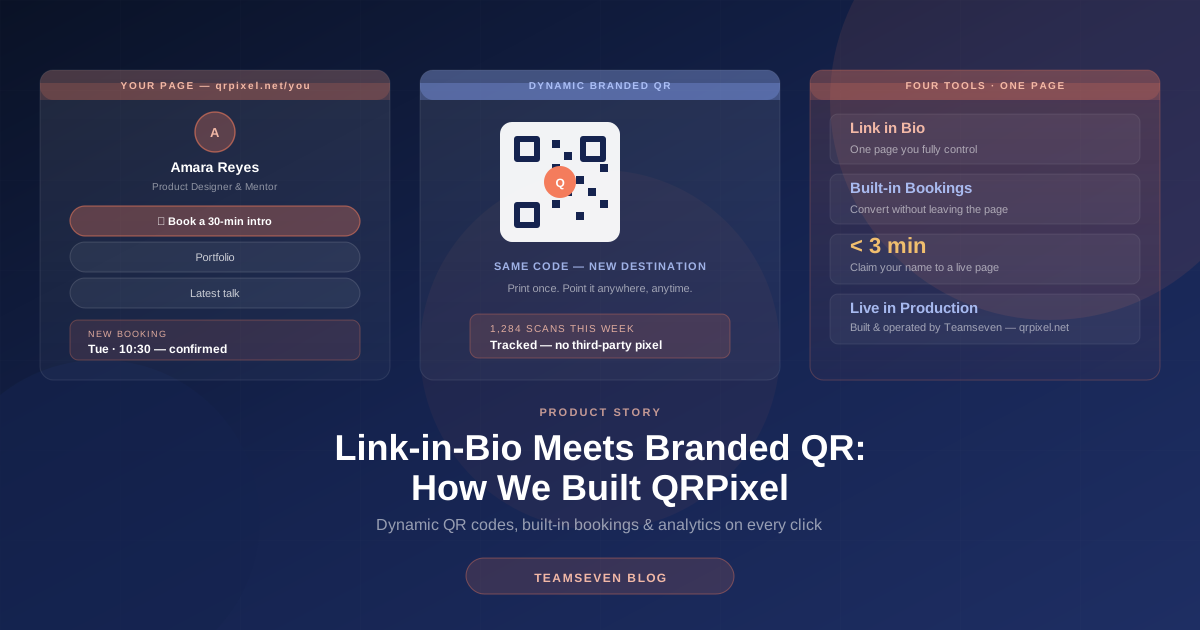
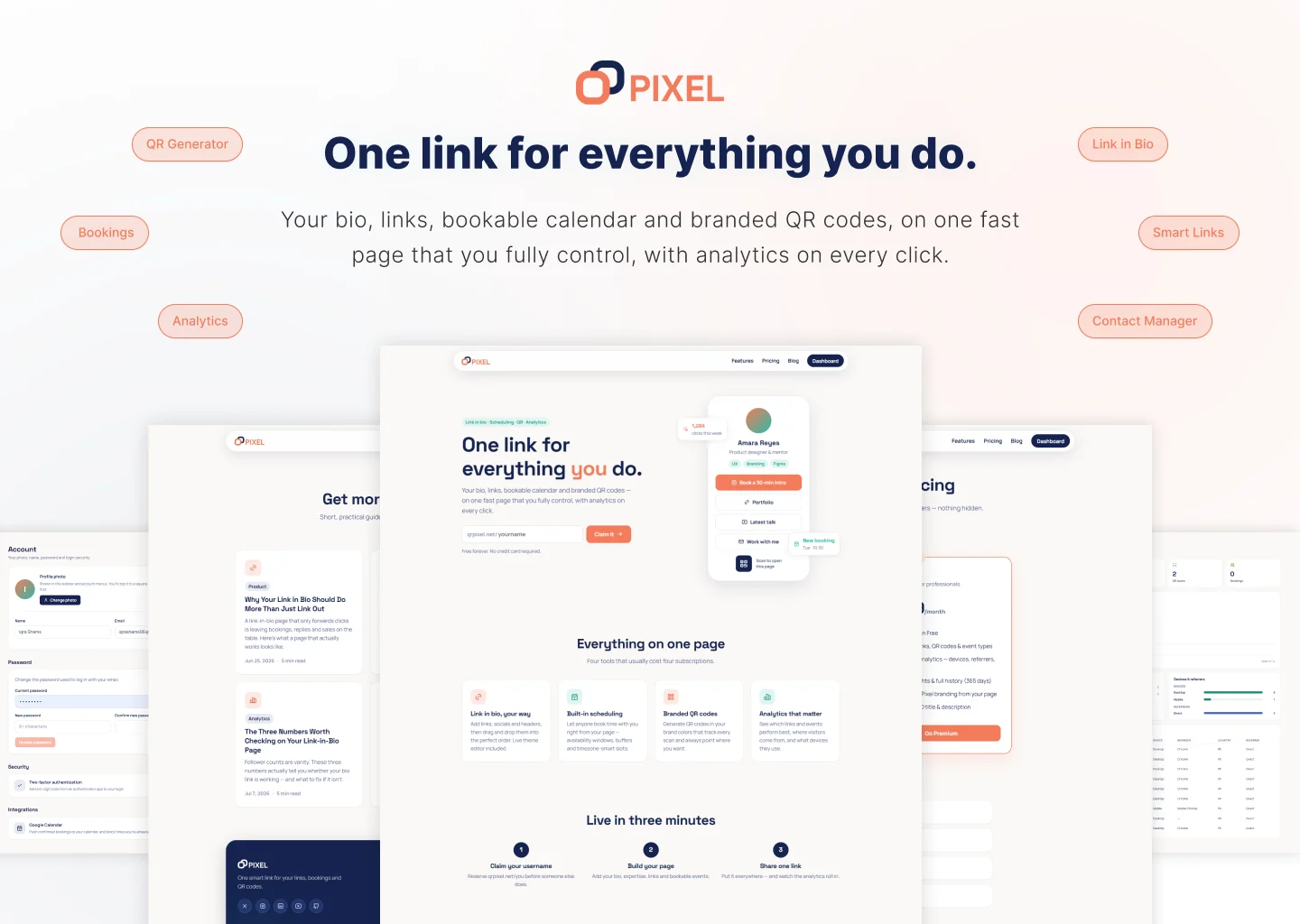
So we built QRPixel: one link for everything you do, live in production today at qrpixel.net. Your bio, links, a bookable calendar, and branded QR codes on one fast page you fully control, with analytics on every click and scan. We're a team that designs, builds, and operates our own SaaS products alongside client work, and QRPixel is one of them. This post is the honest engineering story: what a modern link-in-bio platform requires, why we made the QR codes dynamic, and the decisions I'd defend most.
What is a link-in-bio platform, really?
A link-in-bio platform gives you a single public page, one URL, that carries your identity and everything you want people to do next: follow you, read your work, buy, book, or save your contact details. It exists because most social platforms allow exactly one clickable link, and one link is never enough.
That's the textbook definition. The one that matters is narrower: a link-in-bio page is, for most people, their entire web presence. It's the closest thing a freelancer, creator, or small business has to a website. If you accept that framing, a pile of links stops being good enough, because a real web presence needs to be discoverable, measurable, and controllable, and a static list is none of those.
Why a list of links isn't a product
Plenty of tools will give you a page of links in two minutes. We watched people adopt them and then quietly outgrow them, for four reasons that shaped what QRPixel became:
A link out is a dead end for you. The moment someone taps a link, they leave, and you learn nothing. No sense of which link is working, where visitors came from, or what device they're on. A page that forwards clicks but tells you nothing about them is a page working against its owner.
Booking lives somewhere else. Creators and professionals want people to do something: book a call, a session, a slot. On most link-in-bio tools that means bolting on yet another subscription and yet another link. We put a bookable calendar directly on the page, so the visit can convert without ever leaving it.
QR codes are treated as an afterthought. A QR generator spits out a black-and-white square pointing at a fixed URL. Print it, and you've frozen a decision forever. That's backwards for anyone whose page changes.
No control over how you show up. Search engines and previews read a page's title and description. Most link-in-bio pages hand you a generic one. For something that is your web presence, that's a real cost, which is why QRPixel gives you a custom SEO title and description on your own page.
Why we made the QR codes dynamic
This is the decision I'd defend first. In QRPixel, the printed QR code is not the destination. It's a pointer to a destination you can change at any time. The pattern on the card, the flyer, the shop window never changes; where it resolves to always can.
The distinction sounds small and is enormous. A static QR code encodes a URL directly in the pattern, so changing the URL means reprinting the code. A dynamic QR code encodes a short, stable QRPixel address that redirects to wherever you currently point it. Hand out a business card today, relaunch your whole page next year, and the same card still lands people on your latest offer.
Dynamic-by-default also unlocks the thing a static code can never give you: measurement. Because every scan passes through QRPixel before redirecting, we can attribute it (which code, when, what device) without a tracking pixel following the visitor around the web afterwards. The branding matters too: QR codes carry your colours and design so they belong on your material instead of looking like a parking-meter sticker. Bridging a physical touchpoint to a live, editable page is exactly the kind of custom software problem worth solving properly rather than gluing three tools together.
Analytics on every click is the whole point
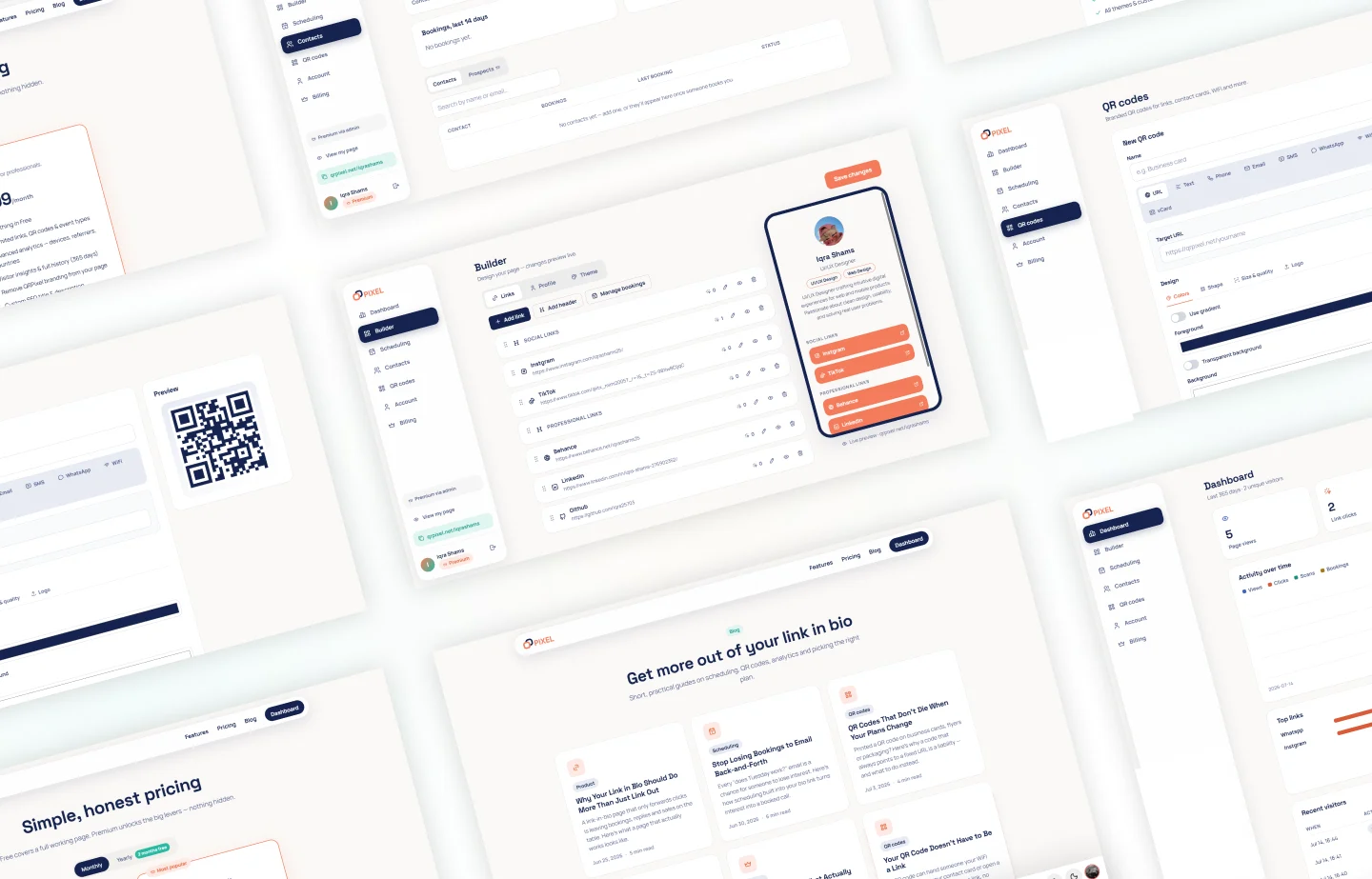
There are three numbers that tell you whether your bio page is working, and most tools show you none of them: how many people landed, what they did next, and where they came from. QRPixel is built so those aren't a premium mystery: page views, link clicks, QR scans, top links, referrers, and device breakdown are the product, not a report you export.
The engineering constraint we set ourselves: analytics you can trust without surveillance you can't defend. That meant first-party measurement: the click passes through our own infrastructure, so we don't need third-party trackers riding along to the visitor's next ten sites. It's the same privacy-first posture we take across everything we build: measure what the owner needs, collect nothing they'd be uncomfortable explaining. A link-in-bio page shouldn't cost its visitors their privacy to give its owner a dashboard.
Everything on one page: without the page getting slow
QRPixel puts four tools that usually cost four subscriptions on one page: link-in-bio, built-in scheduling, branded QR codes, and analytics that matter. The hard part isn't listing those features. It's making them coexist on a page that has to load fast on a phone, on mobile data, the instant someone taps a link in a bio.
Speed is a feature here, not a nice-to-have. A link-in-bio page that takes three seconds to paint has already lost a share of the taps that reached it. So the public page is engineered to be light and to render immediately, with the heavier machinery (the builder, the QR designer, the contact manager, the dashboard) living in the authenticated app behind it. That split (a fast public surface, a rich private one) is a recurring pattern in the SaaS platforms we architect: the page a stranger sees and the console the owner uses have completely different performance budgets, and treating them the same is how products get slow.
Live in three minutes is a product requirement, not a tagline
We measured one number obsessively while building QRPixel: time from "claim your username" to a live, shareable page. The flow is deliberately three steps: claim your name before someone else does, build your page with your bio, links, and bookable events, then share one link and watch the analytics come in.
The reason is unglamorous. The people QRPixel is for evaluate a tool in the gaps of a busy day. If they can't get a real, shareable page live in the first sitting, they don't come back to finish later. They just don't come back. Free forever, no credit card to claim your name, and a Premium tier for full analytics, custom branding, and event types: the paywall sits past the moment of value, not in front of it. Getting that sequence right is most of what separates a SaaS product that grows from one that stalls.
What we learned building QRPixel
Dynamic beats static everywhere, not just in QR codes. The core insight, separate the thing you print from the thing you can change, kept paying off across the product. It's why the page, the links, the booking slots, and the codes are all editable behind a fixed public address. Anything a user commits to the physical world should point at something you can still move.
First-party analytics is a competitive advantage, not a constraint. Choosing to measure clicks through our own infrastructure instead of a third-party tracker looked like the harder path. It turned out to be the better product: faster pages, cleaner data, and a privacy story we can stand behind: the same lesson we keep relearning across our own products.
One page beating four subscriptions is a real wedge. People don't want a link tool and a QR tool and a booking tool and an analytics tool. Collapsing four recurring costs into one page they control is a proposition that explains itself, and building it well is a genuine systems-design problem, not a landing page.
Run your own product and it changes how you build for clients. Operating QRPixel in production (real users, real scans, real edge cases) sharpens how we approach client SaaS builds more than any spec review. It's one thing to ship a system; it's another to own it.
Should you use a link-in-bio tool or build your own?
For almost everyone, the answer is use one. That's exactly why we built QRPixel and made it free to start. A creator or small business does not need to build and maintain their own bio platform, dynamic QR infrastructure, and analytics pipeline. Buy the tool; spend your time on the work.
The build conversation is different, and it's one we have often: a company whose own customers need branded pages, dynamic QR codes, and scan analytics: a franchise, a marketplace, an events business, a product with a physical touchpoint. At that point you're not looking for a link-in-bio subscription; you're looking for custom software with this capability inside your own platform, your own branding, your own data. That's the line we help clients draw: use the product when it's for you, build when the capability has to live inside something you own, the same build-versus-buy judgement that applies to every category of software.
If you're weighing that decision, or you just want to see the ideas above running in production, claim your page on QRPixel, or tell us what you're building and we'll give you an honest read on whether it's a product to subscribe to or a platform to build.
QRPixel is live in production at qrpixel.net: a link-in-bio page, dynamic branded QR codes, a built-in bookable calendar, and real-time click and scan analytics, free forever to start with no credit card required to claim your name. See the full product page →
Stay connected
Build notes, launches, and new articles from the Teamseven team.